
50 Leadership Training Topics for 2026 (With Examples)
This is the most complete list of leadership training topics on the internet.
In this guide you'll get 50 specific topics, grouped into the categories that actually matter, each with a real-world example you can drop straight into a program.
You'll also get the different types of leadership training (the delivery formats, not just the subjects), a breakdown of topics by industry, and what real managers say they wish someone had taught them.
And it's all built for 2026, the year leadership development quietly became the number one L&D priority. According to Absorb's 2026 Enterprise L&D report, leadership development is the #1 priority for L&D teams this year, yet only 11% of L&D leaders feel extremely confident in their skills strategy.
That gap is the whole reason this guide exists.
Let's dive in.
What's in this guide
- Chapter 1: What leadership training actually is (and why 2026 changed it)
- Chapter 2: The 7 types of leadership training
- Chapter 3: 50 leadership training topics, by category (with examples)
- Chapter 4: Leadership training topics by industry
- Chapter 5: What real managers say they actually need
- Chapter 6: How to choose the right topics (and make them stick)
Chapter 1: What leadership training actually is (and why 2026 changed it)
Leadership training is any structured learning that builds the skills people need to lead others: communicating, coaching, deciding, and driving results through a team instead of doing the work themselves.
Simple enough. Here's the problem.
Most organizations promote their best individual contributor and call it a day. And it backfires. Gallup found that companies pick the wrong person for a manager role 82% of the time. Roughly 74% of employees say their managers need reskilling. And even on a core skill like delegation, only about 1 in 5 managers actually excel at it, per DDI.
So the raw material is weak, and the training is often weaker.
Now add 2026 to the mix. Three shifts changed what "good leadership" even means:
- Human + AI leadership. AI stopped being a future thing. Gartner projects that by the end of 2026, 40% of enterprise apps will embed task-specific AI agents, up from under 5% in 2025. Leaders now orchestrate people and tools.
- Burnout and "quiet cracking." DDI flags rising burnout and stalled mobility as defining 2026 trends. Well-being became a leadership skill, not an HR perk.
- The human premium. As AI absorbs technical tasks, the distinctly human skills (empathy, judgment, connection) became the differentiator, not the nice-to-have.
Here's the deal: the best 2026 leadership programs blend timeless fundamentals (feedback, delegation, trust) with a new layer of AI-era and human-centered skills. This guide covers both.
Chapter 2: The 7 types of leadership training
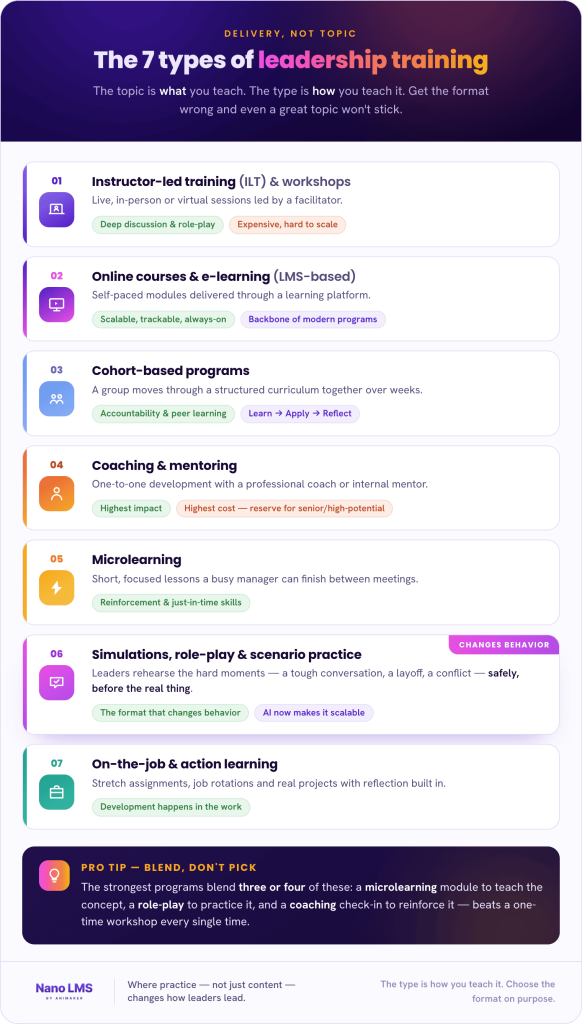
Before the topics, know your delivery options. The topic is what you teach. The type is how you teach it. Get the format wrong and even a great topic won't stick.
1. Instructor-led training (ILT) and workshops. Live, in-person or virtual sessions led by a facilitator. Great for deep discussion and role-play. Expensive and hard to scale.
2. Online courses and e-learning (LMS-based). Self-paced modules delivered through a learning platform. Scalable, trackable, always-on. The backbone of most modern programs.
3. Cohort-based programs. A group moves through a structured curriculum together over weeks. Strong on accountability and peer learning. Think "Learn-Apply-Reflect."
4. Coaching and mentoring. One-to-one development, either with a professional coach or an internal mentor. The highest-impact and highest-cost format. Best reserved for high-potentials and senior leaders.
5. Microlearning. Short, focused lessons a busy manager can finish between meetings. Perfect for reinforcement and just-in-time skills.
6. Simulations, role-play, and scenario-based practice. Where leaders practice the hard moments (a difficult conversation, a layoff, a conflict) in a safe environment before the real thing. This is the format that actually changes behavior, and AI now makes it scalable.
7. On-the-job and action learning. Stretch assignments, job rotations, and real projects with reflection built in. Development happens in the work, not next to it.
Pro tip: the strongest programs blend three or four of these. A microlearning module to teach the concept, a role-play to practice it, and a coaching check-in to reinforce it beats a one-time workshop every single time.
Chapter 3: 50 leadership training topics, by category (with examples)
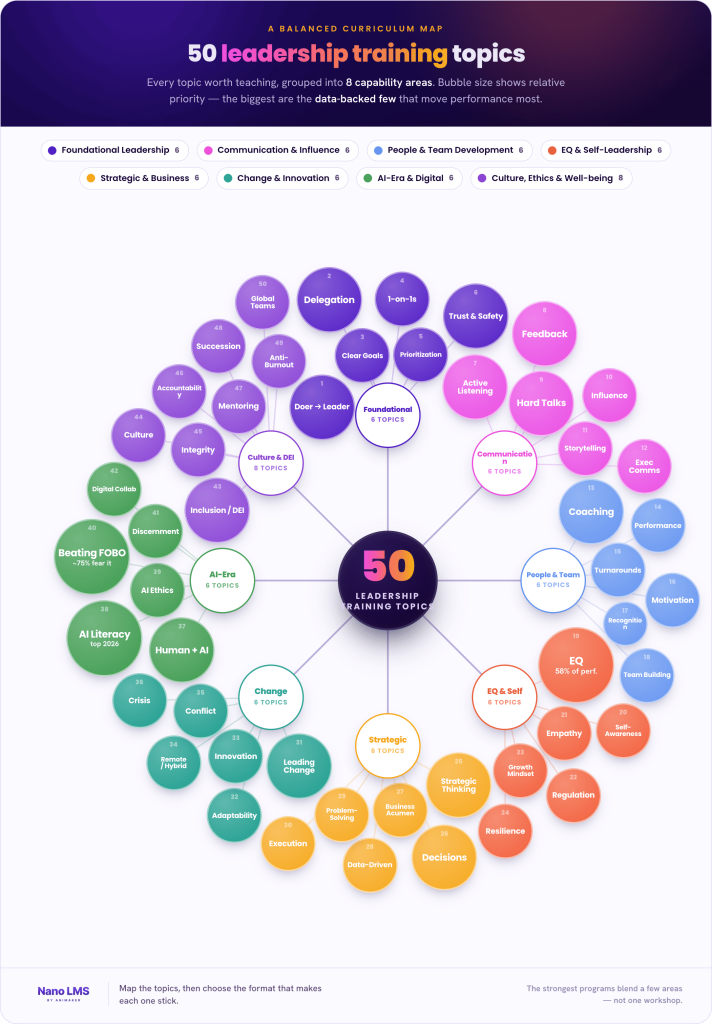
Here they are. I've grouped all 50 into eight categories so you can build a balanced program instead of a random list. Every topic includes a one-line definition and a concrete example.
Foundational leadership (for new managers)
1. The shift from doer to leader. Rewiring your identity from "I do the work" to "I enable the work." Example: A star engineer learns to measure success by the team's shipped output, not their own commits.
2. Delegation. Handing off ownership and authority, not just tasks. Example: Using a delegation-levels framework to give a report a full project with clear decision rights.
3. Setting clear expectations and goals. Defining what "good" looks like before work starts. Example: Writing a shared "definition of done" and SMART goals for each team member.
4. Running effective one-on-ones. Using 1:1s to coach, unblock, and connect. Example: A weekly 20-minute 1:1 where the report, not the manager, owns the agenda.
5. Time management and prioritization. Protecting your time so you can lead, not firefight. Example: Using an Eisenhower matrix to stop pulling individual-contributor tasks back onto your plate.
6. Building trust and psychological safety. Creating a team where people speak up without fear. Example: A manager admits their own mistake in a retro to signal it's safe to do the same.
Communication and influence
7. Active listening. Understanding the message under the words. Example: Reflecting back what a report said before responding during a tense conversation.
8. Giving constructive feedback. Timely, specific, behavior-based feedback that lands. Example: Using Situation-Behavior-Impact instead of the compliment-criticism-compliment "sandwich."
9. Handling difficult conversations. Addressing problems directly instead of avoiding them. Example: A manager rehearses a conversation about a missed deadline before walking into it.
10. Influencing without authority. Getting buy-in from people who don't report to you. Example: A product lead wins engineering's support for a fix using data and stakeholder framing.
11. Storytelling for leaders. Using narrative to align and motivate. Example: Framing a reorg as a story of where the company is heading, not a list of changes.
12. Executive communication. Communicating up with clarity and brevity. Example: Delivering a three-slide update to the leadership team with the ask on slide one.
People and team development
13. Coaching skills. Developing people through questions, not answers. Example: Using the GROW model to help a stuck report reach their own solution.
14. Performance management. Managing and reviewing performance fairly. Example: Running a review tied to the whole cycle's goals, not just last month's memory.
15. Managing underperformance. Turning a struggling employee around, or exiting with dignity. Example: Building a clear improvement plan with support, milestones, and honest check-ins.
16. Motivating and engaging teams. Tapping intrinsic motivation, not just incentives. Example: Connecting one person's project to the company mission in a 1:1.
17. Recognition and appreciation. Rewarding the behaviors you want repeated. Example: Specific public praise ("the way you de-escalated that client call") over a generic "great job."
18. Team building and collaboration. Turning a group of individuals into a team. Example: Co-creating team working agreements on how you'll make decisions and handle conflict.
Emotional intelligence and self-leadership
19. Emotional intelligence (EQ). Self-awareness, empathy, and regulation. TalentSmart data ties EQ to 58% of job performance. Example: Naming your own frustration before a tense meeting so it doesn't leak into the room.
20. Self-awareness. Knowing your style, strengths, and blind spots. Example: Using a 360 assessment to discover you're a bottleneck because you won't delegate.
21. Empathy and compassion. Seeing your team as whole people. Example: Rebalancing a report's workload when they're going through a hard time at home.
22. Emotional regulation and stress management. Staying steady when things aren't. Example: A brief pause-and-breathe reset before responding to bad news in front of the team.
23. Growth mindset and continuous learning. Modeling that leaders are perpetual students. Example: A leader shares a course they're taking and something they recently got wrong.
24. Personal resilience and well-being. Sustaining yourself so you can sustain others. Example: Blocking no-meeting focus time and actually defending it to prevent burnout.
Strategic and business leadership
25. Strategic thinking. Connecting daily work to the bigger picture. Example: Translating a company strategy into three clear priorities for your team.
26. Decision-making. Making structured, timely calls under uncertainty. Example: Sorting choices into reversible "two-way doors" and irreversible "one-way doors" to decide how fast to move.
27. Financial and business acumen. Reading the numbers that run the business. Example: A team lead uses a simple P&L to justify a new headcount request.
28. Data-driven leadership. Deciding with evidence, not gut alone. Example: Using a dashboard to pull effort off a stalling initiative before it drains the quarter.
29. Problem-solving and critical thinking. Structured analysis over reactive fixes. Example: Running a "5 Whys" root-cause session on a defect that keeps recurring.
30. Project and execution management. Delivering reliably, on time. Example: Scoping risks up front and running a short weekly execution review.
Change, innovation, and resilience
31. Leading through change. Guiding people through transitions. Example: Using a change model like ADKAR to roll out a new process without losing morale.
32. Adaptability and change fitness. Thriving when change is constant, not occasional. Example: Reframing a sudden strategy pivot as an experiment the team runs together.
33. Innovation and creative thinking. Creating the conditions for new ideas. Example: Running a structured "How might we..." session instead of a vague brainstorm.
34. Leading remote and hybrid teams. Leading people you don't sit next to. Example: Designing async updates so remote members aren't second-class citizens in decisions.
35. Conflict management and resolution. Turning friction into progress. Example: Mediating two reports by surfacing their shared interests, not relitigating positions.
36. Crisis leadership. Leading calmly under acute pressure. Example: Running an incident with clear roles, a single source of truth, and steady comms.
AI-era and digital leadership (new for 2026)
37. Human + AI leadership. Orchestrating a team and its AI tools together. Example: A manager redesigns a workflow around an AI copilot and coaches the team through the change.
38. AI literacy and digital fluency. Understanding what AI can and can't do. Absorb's 2026 report ranks digital fluency among the top capabilities for the year. Example: A leader learns prompting basics so they can fairly evaluate AI-assisted work.
39. AI ethics and responsible use. Governing how AI gets used on the team. Example: Setting guardrails for what AI may never touch, like raw customer data.
40. Leading through uncertainty and FOBO. Calming "fear of becoming obsolete." EY found roughly 75% of employees worry AI will make some jobs obsolete. Example: A leader openly addresses "will AI replace us" fears and shares a concrete reskilling plan.
41. Discernment and judgment. Quality-controlling AI output instead of trusting it blindly. Example: Teaching the team to verify and pressure-test AI answers before shipping them.
42. Digital collaboration. Leading well inside a modern tool stack. Example: Standardizing where decisions get documented so they don't vanish into chat threads.
Culture, ethics, DEI, and well-being
43. Inclusive leadership and DEI. Leading diverse teams equitably. Example: Structuring meetings so quieter voices get airtime, not just the loudest.
44. Building and shaping culture. Reinforcing the behaviors you want on purpose. Example: Naming team values and calling them out live when someone lives them.
45. Ethical leadership and integrity. Modeling the hard, honest call. Example: Choosing transparency over spin when a project slips, and owning it.
46. Accountability and ownership. Moving a team from blame to responsibility. Example: Using a "ladder of accountability" to shift a team from excuses to owning the outcome.
47. Mentoring and sponsorship. Actively developing the next generation of leaders. Example: A senior leader sponsors a high-potential for a visible stretch project.
48. Succession planning. Making sure no key role has a single point of failure. Example: Identifying and developing a ready backup for every critical position.
49. Preventing team burnout. Protecting your team's energy, not just your own. Example: Spotting "quiet cracking" signals early and rebalancing load before someone breaks.
50. Cross-cultural and global leadership. Leading across cultures and time zones. Example: Adapting your feedback style to fit the norms of a global, distributed team.
Chapter 4: Leadership training topics by industry
The fundamentals travel. The emphasis changes by industry. Here's how to tailor the list for five common verticals.
Technology and software
Engineers get promoted for being the best coder, then discover leading is a completely different job. Prioritize:
- The doer-to-leader shift (letting go of being the best individual contributor)
- Technical decision-making without micromanaging the how
- Leading remote and async teams
- Human + AI leadership, since these teams feel the AI shift first
Healthcare
High stakes, high burnout, and leaders often promoted from clinical roles. Prioritize:
- The clinician-to-manager transition
- Leading multidisciplinary teams (nurses, physicians, admin) toward one goal
- Compassion, well-being, and burnout prevention, which are patient-safety issues, not soft ones
- Difficult conversations in emotionally charged, high-consequence settings
Manufacturing
Frontline, deskless, and facing an aging workforce and a succession gap. Prioritize:
- Frontline and shop-floor leadership
- Safety leadership and a culture of accountability (the "ladder of accountability")
- Lean thinking and continuous improvement
- Succession planning, because a generation of expertise is retiring
Retail and hospitality
High turnover, hourly teams, and multi-location consistency. Prioritize:
- Coaching in the moment on a busy floor
- Fast onboarding and motivating hourly teams
- Customer-experience leadership
- Holding brand standards consistent across locations
Financial services
Heavily regulated, trust-dependent, and risk-sensitive. Prioritize:
- Ethical leadership and integrity
- Risk-aware decision-making
- Leading through compliance and regulation
- Building client and stakeholder trust
Sales bonus: if you lead a revenue team, add sales-specific manager topics like pipeline coaching, motivating quota-carriers, and the rep-to-manager transition. (We wrote a full guide on the tools for that in our best LMS for sales training post.)
Chapter 5: What real managers say they actually need
Read enough manager forums and communities and the same confessions show up on repeat. The official topic list is one thing. Here's what keeps new managers up at night.
"I can do it faster myself." Delegation is the single most-cited struggle. High performers built their identity on personal output, so letting go feels like losing value. This is exactly why only about 1 in 5 managers excel at it. If you teach one thing, teach this.
Nobody trained me for the people part. Most new managers got sales, product, or technical training, never management training. Then on day one they're expected to run reviews, handle HR issues, and have hard conversations they've never practiced.
I avoid the difficult conversation. New managers routinely dodge the tough talk until a small problem becomes a big one, or they swing too hard the other way. Difficult conversations and feedback are the skills people most want and least receive.
My feedback isn't landing. Managers lean on the "feedback sandwich" and wonder why nothing changes. The people who improve are the ones taught to give specific, behavior-based feedback and to follow up.
The identity crisis is real. The jump from "master of my craft" to "person who gets results through others" is a genuine mindset shift, and most programs skip it entirely.
The takeaway: if your program only covers strategy and vision, you're solving the wrong problem. Ground it in the unglamorous fundamentals (delegation, feedback, difficult conversations, the doer-to-leader shift) because that's where managers are actually drowning.
Chapter 6: How to choose the right topics (and make them stick)
Fifty topics is a menu, not a meal. Here's how to build the plate.
Step 1: Choose by leader level.
- New managers: foundational topics (delegation, feedback, 1:1s, the doer-to-leader shift).
- Mid-level leaders: strategy, decision-making, leading change, coaching.
- Senior leaders: vision, culture, succession, ethical and AI governance.
Step 2: Choose by skills gap, not vibes. Use a 360 or a simple assessment to find where your leaders actually struggle, then build around that. Evidence-based development is a defining 2026 trend for a reason.
Step 3: Choose by business goal. Losing people? Prioritize coaching, feedback, and well-being. Going through a reorg? Change leadership and communication. Rolling out AI? Human + AI leadership and discernment.
Then, the part everyone gets wrong: delivery.
A leader can watch a 40-minute video on "difficult conversations," pass the quiz, and still freeze in the real one. Completion is not competence. Behavior changes when people practice. The research-backed pattern is Learn, Apply, Reflect: teach the concept, let them practice it in a safe space, then reinforce it on the job.
That's the whole case for pairing content with role-play and scenario practice. Instead of reading about giving feedback, a new manager rehearses the exact conversation with an AI that pushes back, gets scored, and tries again before it's a real person's career on the line.
This is where a modern, AI-native LMS earns its place. With Nano LMS, you can turn your existing leadership material (a framework doc, a deck, a recorded workshop) into a structured course in minutes, then add AI Roleplay so leaders practice the hard moments (a difficult conversation, a delegation handoff, a performance review) instead of just watching a lesson about them. You get the content and the reps, tracked in one place, on a free tier you can start today.
Because in the end, you don't build leaders by informing them. You build them by letting them practice.
Now I'd like to hear from you
That's my list of 50 leadership training topics for 2026.
Which one is the biggest gap on your team right now? Is it the delegation trap? Difficult conversations? Or leading through the AI shift?
If you want to see what practice-first leadership training actually feels like, you can [spin up Nano LMS free], build a course from a doc you already have, and drop a manager into an AI role-play in about the time it took to read this guide.
Now go build some leaders.