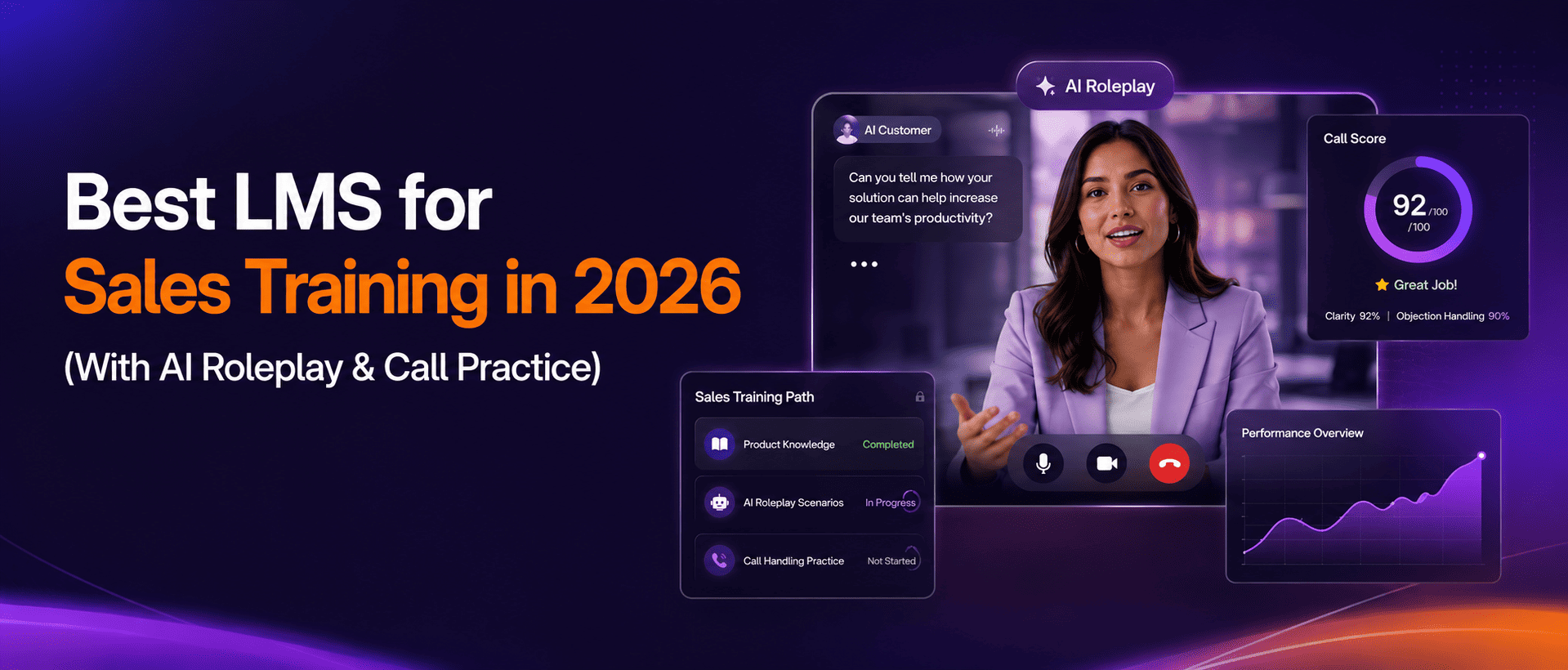

9 Best LMS for Sales Training in 2026 (With AI Roleplay & Call Practice)
Let me save you three weeks of demos and a graveyard of "request pricing" buttons.
Most "best sales training LMS" lists are useless. They rank 20 tools nobody actually uses, bury them under affiliate links, and never once ask the only question that matters: does this thing make your reps better on a live call?
Here's the uncomfortable truth about sales training. Your reps don't get better by watching a 40-minute video on objection handling and clicking Next. They get better by doing the thing. Badly, then less badly, then well. Repetition under pressure is the whole game. Everything else is content.
And yet most LMS platforms are glorified filing cabinets. They store courses and track completions. Completion is not competence. A rep can finish 100% of your onboarding and still freeze the second a prospect says "send me some info and I'll think about it."
That's why the market moved. The best sales training platforms in 2026 don't just deliver content, they let reps practice conversations with AI, get scored, and do it again before they ever touch a real pipeline. It's the difference between reading about swimming and getting in the water.
So this list is filtered on exactly that. Every platform below is a real training system with AI roleplay or call practice baked in, sorted by who it's actually for. No filler. Let's get into it.
First, though, the part everyone skips and then regrets.
What to look for in a sales training LMS (before you sign anything)
Buy the wrong platform and you don't just waste money. You waste a year, because switching an LMS mid-cycle is brutal. Here's what actually separates a tool your reps use from a tool your reps ignore. And they will ignore it: one industry survey found roughly three out of four sales leaders logged into their enablement platform fewer than five times last quarter. That's not a people problem. That's a product-fit problem.
Run every demo through these eight filters.
1. AI roleplay and call practice (non-negotiable in 2026)
This is the whole reason you're reading a list with "AI Roleplay" in the title. Can a rep practice a discovery call, a pricing objection, or a cold open against an AI buyer that talks back, and get scored on it? And here's the sharper question most buyers forget to ask: is the roleplay auto-generated from what's actually going wrong on real calls, or is it a static library some admin has to build by hand? The former scales across your whole team. The latter dies the week your enablement person gets busy.
2. Speed of content creation:
This is the silent killer. Ask any vendor how long implementation takes and listen for the word "content." The dirty secret of enterprise readiness platforms is that the software is ready in weeks but the courses take months, because your subject matter experts are your senior reps, and they have zero time to build training. If your reps are the bottleneck, you don't have a training program. You have a backlog. Prioritize tools that turn an existing doc, deck, or recorded call into a course in minutes.
3. CRM and workflow integration:
Reps live in Salesforce, Slack, and Teams. If training makes them log into a separate portal, adoption tanks. Learning has to happen in the flow of work, not in a browser tab they forgot the password to.
4. Coaching and manager feedback loops:
The best learning happens when a manager reviews a practice pitch and gives targeted feedback. Look for practice submissions, scorecards, and manager review workflows, not just an auto-grade the rep never reads.
5. Analytics that tie to revenue, not completions:
The 2026 buyer bar is simple: every training dollar should map to a revenue metric. "94% course completion" tells you nothing. "Reps who passed the pricing roleplay close 12% more" tells you everything. Ask what the platform correlates practice against.
6. Mobile and microlearning:
Reps are on the road, between meetings, killing time in an airport. If your training isn't short and phone-friendly, it doesn't happen.
7. Ramp time and role-based paths:
New reps take three to nine months to get fully productive. A good platform attacks that number directly with role-based onboarding paths, not one generic firehose course for everyone.
8. Pricing and a free path:
Most of the heavyweights on this list are quote-based and enterprise-priced, meaning a sales call before you see a number. If you're an SMB or you just want to test the water without a procurement cycle, a free tier or published per-user pricing matters a lot.
Keep those eight in your head. Now the platforms.
The 9 best LMS for sales training in 2026
Quick note on how to read this. Some of these are full learning management systems. Some are sales enablement or readiness platforms that do training plus a lot more. A couple are focused practice tools you bolt onto whatever you already have. I've flagged which is which, because "best" depends entirely on the problem you're solving.
1. Nano LMS
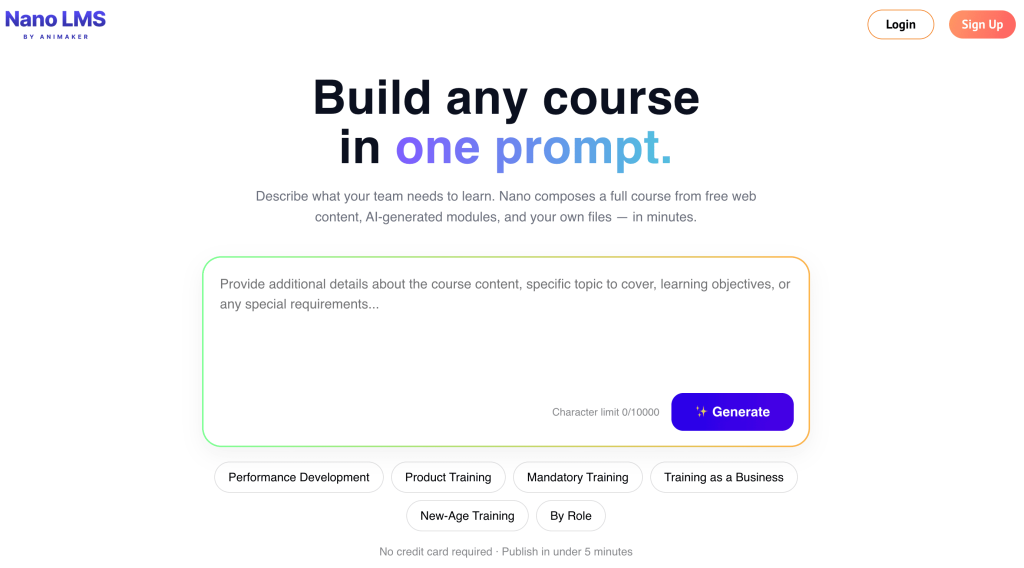
Best forAI-native course creation plus built-in practice,free to start.
Start here if your real problem isn't delivering training, it's building it fast enough to keep up.
Nano LMS flips the model. Instead of you spending three hours building a course, you describe what you want trained in a chat, point it at a PDF, a sales deck, or a recorded call, and it drafts the whole thing: structure, video lessons, quizzes, and a certificate, in minutes. Then you edit. Think less "timeline editor" and more "tell it what you want."
On the practice side, this is where it earns its spot on a roleplay list. Reps can rehearse real conversations with an AI buyer through chat sims and voice-style roleplay, practice inside a simulated CRM or tool with interface sims, and work branching scenarios that score their judgment. So you're not just handing reps content, you're giving them reps.
The honest part, because you should trust a list that admits trade-offs: Nano is the newer name here. If you need a decade-deep readiness index correlating every micro-behavior to quota across a 2,000-seat org, the enterprise suites below go deeper on analytics. But for the vast majority of teams that need to build real sales training fast, let reps practice, and not blow the budget, Nano LMS Sales Training Software is the most direct path. It's built by the Animaker team (35M+ creators), so the video and character DNA is genuinely strong.
Best for:
SMBs and mid-market teams that want to create and update sales training fast, with practice built in. AI roleplay/call practice: Yes. Chat sims, interface sims, scenario roleplay.
Pricing: Free forever tier (1 trainer, 10 learners, 100 AI credits a month, no credit card). Paid tiers scale from there.
2. Mindtickle
Best for enterprise sales readiness at scale.
If you're a large revenue org and budget isn't the blocker, Mindtickle is the heavyweight. It's less an LMS and more a full sales readiness platform: onboarding boot camps, certification tracks, reinforcement, content management, and one of the strongest AI roleplay implementations in the category, all tied together by a "Readiness Index" that measures rep competency instead of just course completion.
The killer feature in 2026 is that its roleplay and coaching can connect to real call data, so practice gets pointed at the gaps actually showing up on live calls. That closed loop is genuinely powerful.
The catch: it's enterprise-only, sold through a sales rep, with no free plan and no public pricing (third-party procurement data pegs typical contracts in the tens of thousands per year). And by their own implementation notes, the content build is the bottleneck, so plan for six to ten weeks and internal enablement muscle before it's live.
Best for:
Enterprise revenue teams that want everything in one system and can staff it. AI roleplay/call practice: Yes, best-in-class, voice-based.
Pricing: Quote-based, enterprise. No free plan.
3. Allego
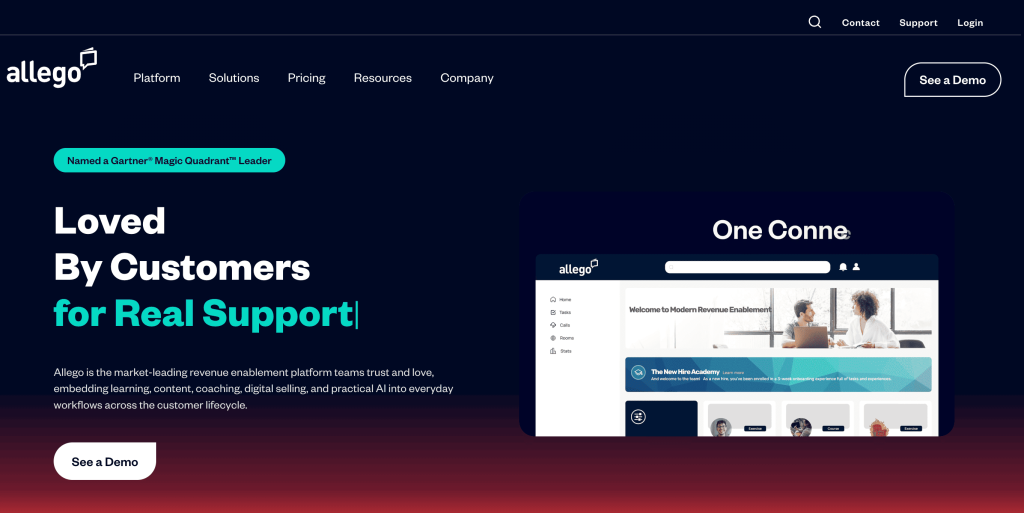
Best for video coaching and conversation intelligence.
Allego anchors enablement around video: reps record pitches, managers coach on them, and the platform layers in conversation intelligence, content management, and roleplay. If your team is distributed and you want async video coaching to be the heartbeat of how reps improve, Allego is built for exactly that.
It sits in the same enterprise/mid-market tier as Mindtickle and gets compared to it constantly. Allego leans more video-and-coaching-first; Mindtickle leans more structured readiness-first.
Best for:
Distributed teams that want video-based practice and coaching at the center. AI roleplay/call practice: Yes, plus strong video coaching workflows.
Pricing: Quote-based.
4. SalesHood
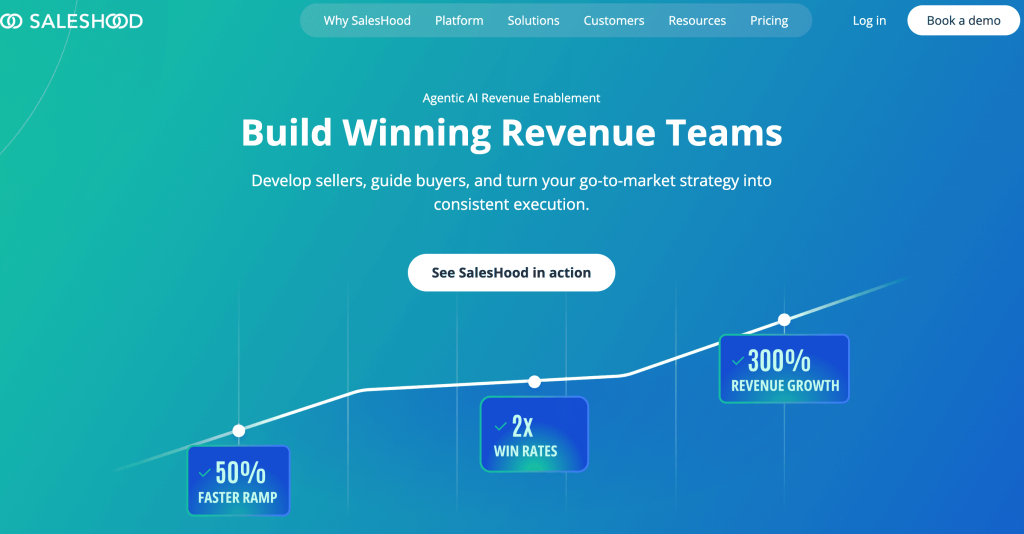
Best for fast mid-market rollout and peer coaching.
SalesHood was founded by Elay Cohen, who ran sales productivity at Salesforce, and the product carries that operator instinct. It's prescriptive about cadence and built around "Huddles," where teams share pitches, best practices, and deal-win stories. It also does AI roleplay with automated feedback, playbooks, and digital sales rooms.
The pitch is speed. Where the big suites take quarters to stand up, SalesHood is designed to be running in weeks, with friendlier pricing. If you're a high-growth or mid-market team that finds the enterprise platforms too heavy, this is the sweet spot.
Best for:
Mid-market teams that want structure and peer coaching without an enterprise lift. AI roleplay/call practice: Yes, with automated feedback.
Pricing: Quote-based, generally friendlier than the enterprise tier.
5. Docebo
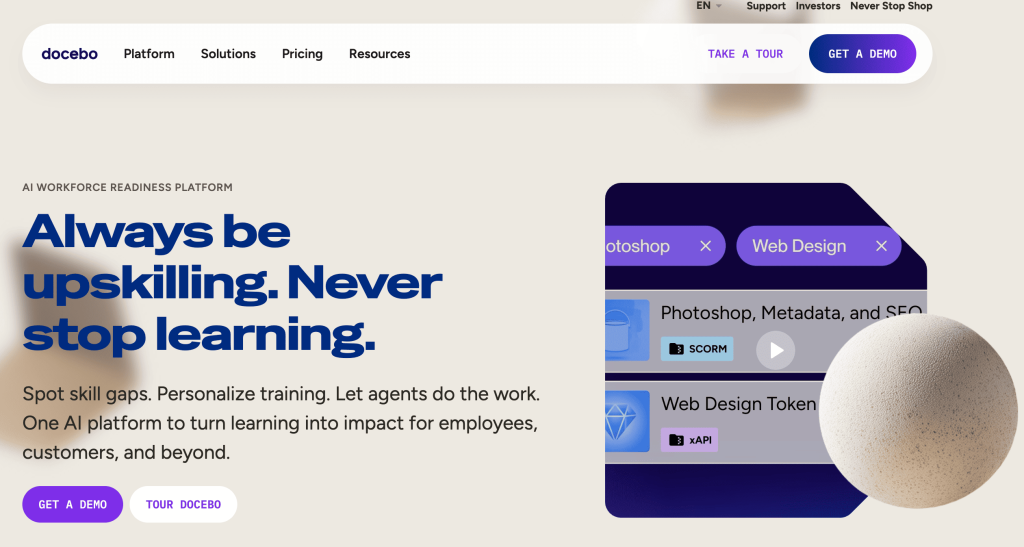
Best for enterprise LMS with sales enablement.
If you want a true enterprise LMS that also handles sales training (not the other way around), Docebo is a strong pick. It's flexible, integrates with Salesforce, Slack, and Teams to keep learning in the flow of work, and ships a branded mobile app that works offline. Docebo's own case studies love to cite fast ramp, associates trained and selling within days.
It's a broad, configurable platform rather than a sales-specific practice tool, so you get more general-purpose LMS power and slightly less out-of-the-box sales roleplay depth than the pure readiness suites.
Best for:
Enterprises that want one flexible LMS across the org, sales included. AI roleplay/call practice: Some, via its AI and enablement features. Less roleplay-native than Mindtickle.
Pricing: Quote-based, enterprise.
6. TalentLMS
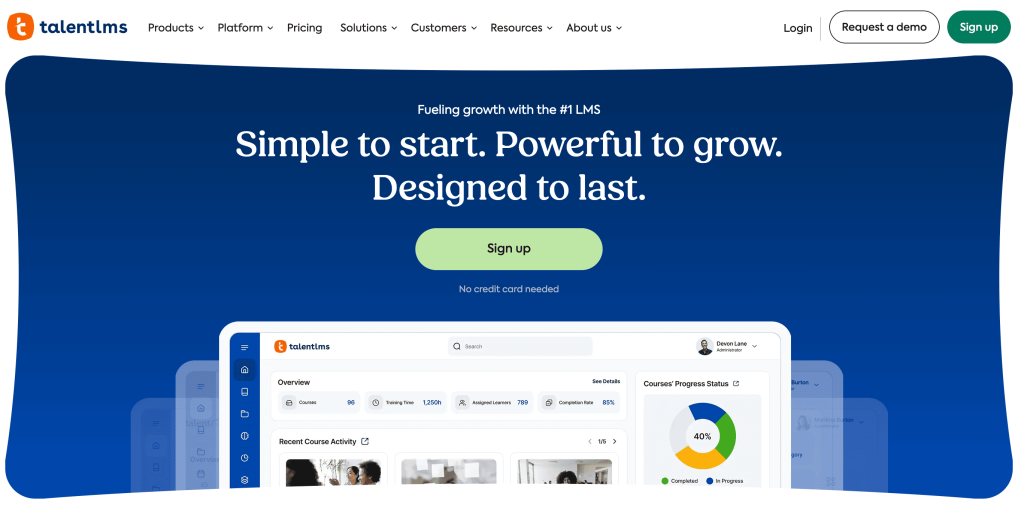
Best for SMBs that want simple and affordable.
TalentLMS is the friendly, no-drama pick for smaller teams. It's genuinely easy to set up, well-priced, integrates with Salesforce so training and CRM data sync, and includes AI assisted features like a personal practice coach for reps. Reviewers consistently call out value for money and speed to launch.
Crucially, it has a forever-free account and published, transparent pricing, so you can evaluate it without a sales call. For a small sales team that wants to stop winging onboarding, it's a low-risk starting point.
Best for:
Small and mid-size teams that want simple, affordable, fast. AI roleplay/call practice: Lighter, via AI practice/coaching features.
Pricing: Free plan available, then published per-user pricing.
7. iSpring Learn
Best for PowerPoint-to-course authoring on a budget.
iSpring's edge is authoring. Pair iSpring Learn (the LMS) with iSpring Suite and your team can turn PowerPoint decks into interactive courses fast, including role-play conversation simulations for practicing dialogue. It's SCORM-solid, strong on compliance tracking, mobile-friendly, and priced on an affordable per-active-user model with a free trial.
It's built for small businesses first, and customization is more limited than the big enterprise suites, but for teams that already live in PowerPoint and want to convert that into real e-learning cheaply, it's hard to beat on value.
Best for:
Budget-conscious teams that want to author their own content, fast. AI roleplay/call practice: Conversation/dialogue simulations for practice.
Pricing: Affordable per-active-user, free trial.
8. SmartWinnr
Best for gamified reinforcement and field sales.
SmartWinnr is sales-specific and leans hard into reinforcement: AI roleplays, gamified contests and leaderboards, spaced knowledge quizzes pushed to reps, and coaching. It's especially popular with large field-sales teams in regulated industries like pharma, insurance, and financial services, where you need to keep hundreds of reps sharp on the same message.
If your problem is less "onboard new reps" and more "keep a big field team consistent and motivated over time," this is a strong fit.
Best for:
Large field-sales teams that need ongoing reinforcement and gamification. AI roleplay/call practice: Yes, plus reinforcement quizzing.
Pricing: Quote-based.
Best for pure AI call and pitch practice.
Not an LMS, and I'm including it on purpose. Second Nature is a focused AI roleplay tool where reps practice their pitch against an AI persona, sometimes with 3D animated avatars for a face-to-face feel, and get feedback to improve on their own. If your training content is already handled and the only gap is call practice, a specialist tool like this can out-practice a general LMS.
The trade-off is obvious: it does one thing. You'll still need something to house courses, track completion, and certify. Think of it as the practice layer you bolt onto whatever LMS you already run.
Best for:
Teams that have content sorted and just need serious call practice. AI roleplay/call practice: Yes, it's the entire product.
Pricing: Quote-based, no public pricing.
Quick comparison
| Platform | Best for | AI roleplay / call practice | Free option | Pricing |
|---|---|---|---|---|
| Nano LMS This guide | Fast course creation + practice | Yes — chat, interface, scenario | Free forever tier | Free, then scales |
| Mindtickle | Enterprise readiness at scale | Yes — best-in-class | No | Enterprise quote |
| Allego | Video coaching + conv. intelligence | Yes | No | Quote |
| SalesHood | Fast mid-market rollout | Yes | No | Quote — friendlier |
| Docebo | Enterprise LMS + enablement | Some | No | Enterprise quote |
| TalentLMS | Simple, affordable SMB | Lighter | Yes | Free + published |
| iSpring Learn | Budget authoring | Dialogue sims | Trial | Per-active-user |
| SmartWinnr | Gamified field-sales reinforcement | Yes | No | Quote |
| Second Nature | Pure call practice add-on | Yes | No | Quote |
So which one should you actually pick?
Cut through it like this.
If you're an SMB or mid-market team and you want to build real sales training fast, let reps practice, and start without a procurement cycle, begin with Nano LMS and its free tier. You'll know inside a day whether it fits, which is more than you can say for any tool that hides its price behind a demo.
If you're a large enterprise with budget and a dedicated enablement team, look hard at Mindtickle or Allego. You're buying depth and readiness analytics, and you'll pay for it.
If content is your gap, not practice, iSpring or TalentLMS get you authoring cheaply. If practice is your only gap, bolt on Second Nature.
But whatever you choose, apply the one test that matters. Steve Jobs used to say people don't know what they want until you show it to them. Sales training is the opposite: your reps know exactly what they need, which is to practice the hard conversation before it costs them a deal. Pick the platform that lets them do that the most, with the least friction. Everything else is a feature list.
Want to see practice-first training in action?
You can spin up Nano LMS free, no credit card, and build your first sales course from a doc you already have in about the time it took to read this post. Then drop your reps into an AI roleplay and watch them practice the objection that keeps costing you deals.
we'll build one with you.
FAQ
- What is the best LMS for sales training in 2026?
It depends on your size. For SMB and mid-market teams that want fast course creation plus built-in AI practice, Nano LMS is a strong starting point because of its free tier and creation speed. For large enterprises, Mindtickle and Allego lead on depth and readiness analytics.
2. What is AI roleplay in sales training?
AI roleplay lets a rep practice a real sales conversation, like a discovery call or a pricing objection, against an AI buyer that responds dynamically and scores the rep on things like tone, pacing, and response quality. It gives reps a safe place to fail and improve before they're on a live call.
3. Do I need a full LMS or just a call-practice tool?
If you need to host courses, track completions, certify reps, and run onboarding, you need an LMS. If all of that is handled and your only gap is practice, a focused tool like Second Nature can layer on top. Many teams run a creation-first LMS plus a practice layer.
4. How much does a sales training LMS cost?
It ranges widely. SMB-friendly tools like TalentLMS and iSpring publish affordable per-user pricing and offer free plans or trials. Enterprise readiness platforms like Mindtickle are quote-based, and third-party data suggests contracts often run into the tens of thousands per year.
5. How long does it take to launch sales training on an LMS?
The software is usually ready in days to weeks. The real timeline is content. Enterprise rollouts can take six to ten weeks largely because building the courses is the bottleneck, which is exactly why AI-native, creation-first platforms are gaining ground.