
Customer Service Training: 19 Examples You Can Steal in 2026
Let me be real with you.
Most customer service training is a complete waste of money.
Not because training doesn't work. Because most of it has no point. It's a slideshow about "being nice," a quiz nobody remembers, and a certificate that changes exactly nothing on Monday morning. Feel-good. Zero impact. Money lit on fire.
Here's the thing nobody wants to say out loud: customer service training should tie to a business number, or you shouldn't run it. Faster resolution. Higher CSAT. Lower churn. More expansion revenue. If a training example can't point to one of those, it's a hobby, not a strategy.
So that's how I built this list. 19 real customer service training examples you can steal today. And every single one is attached to a goal and a business impact. No fluff. No "empower your team to delight." Just what to train, why, and what it does to the P&L.
Let's go.
First, get this through your head: support is a revenue engine, not a cost center
Before you spend a dollar on training, you need to believe the money is real. It is. Look at the math.
Retention is the whole game. Bain and Harvard Business Review found that a 5% increase in retention lifts profits by 25% to 95%. Not 5%. Up to 95%. And retaining a customer is roughly 5x cheaper than acquiring a new one, while repeat customers spend about 67% more than first-timers. Your support team touches those customers more than anyone else in the company. Read that again.
Great service prints money on both sides. PwC found 86% of buyers will pay more for a better experience. Salesforce found 89% of customers are more likely to buy again after a good service interaction. And it's a pre-sale weapon too: around 60% of people decide to buy based on the service quality they expect before they ever touch the product.
Bad service torches it just as fast. PwC found 33% of customers walk after a single bad experience. The Qualtrics XM Institute estimated roughly $3 trillion in global revenue was at risk from poor CX in 2025. Trillion. With a T.
And in 2026, it's board-level. Per Forrester's 2026 CX Index, the average S&P 500 company now attributes 14% of its revenue variance to CX quality, up from 9% in 2023. CX stopped being a "brand thing." It's an operating number now.
So no, this isn't soft. Every training example below is a lever on those numbers. That's the mindset. Now let's talk about what the best in the business are actually doing.
What Intercom, Freshworks, and Freshdesk are actually saying in 2026
I dug through what the platforms who live and breathe this stuff are publishing. Three things jumped out.
1. The whole game went AI-first, and training changed with it. Intercom straight up calls itself the helpdesk for the AI agent era, and their support-team content isn't about scripts anymore. It's about training your people to work alongside AI. Their sharpest idea: treat the human handoff as a feature, not a failure. AI handles the easy 50-plus percent of tickets, and your humans get trained up for the hard, emotional, high-value moments AI kicks over to them.
2. The fundamentals still win, done well. Freshworks and Freshdesk's guide hammers the basics that never go out of style: teach your company, values, and product cold, get everyone talking in a consistent brand voice, and let people practice with each other. Boring? Maybe. Effective? Absolutely.
3. It's continuous, and it's practice-based. Across Intercom, Freshworks, HubSpot, and Salesforce, the same two words show up again and again: role-play and simulation. Not "watch a video." Practice the actual conversation. And not once at onboarding, but as an ongoing habit with regular skills check-ins.
Keep those three in your head. Now the 19.
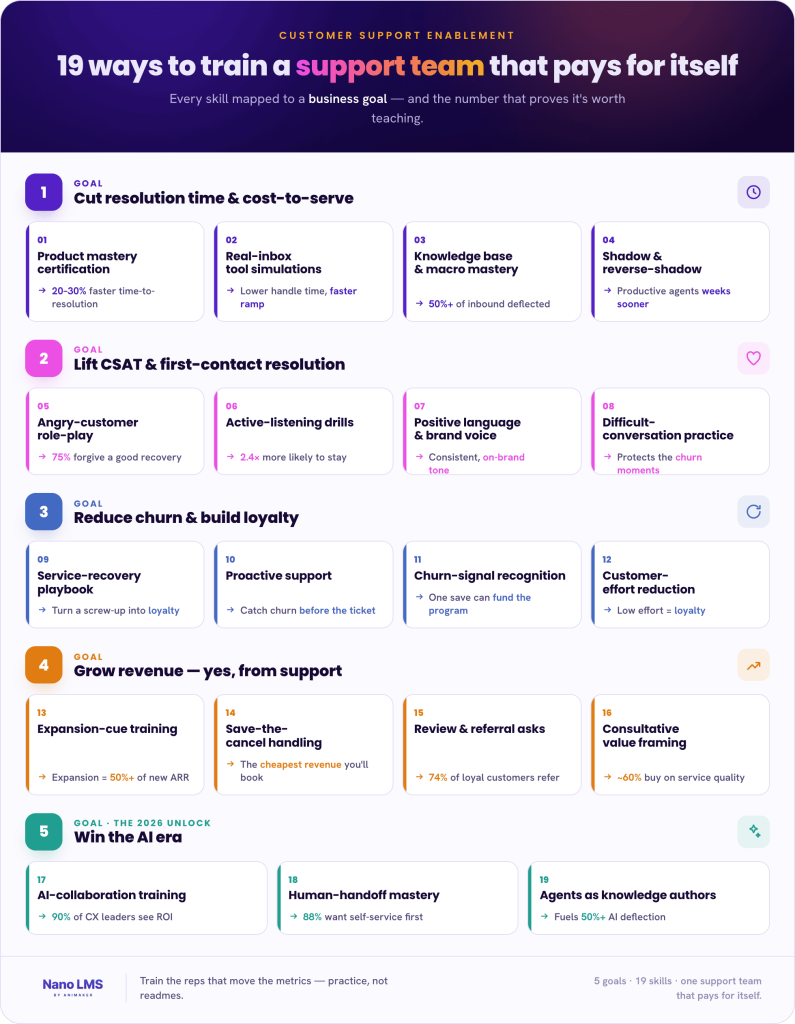
The 19 customer service training examples (goal-based)
I grouped these by the business goal they move. Steal the ones that map to the number you're trying to hit this quarter.
Goal 1: Cut resolution time and cost-to-serve
1. Product mastery certification. Make every agent certify on your product cold, not "familiar with," fluent. Real scenarios, not a glossary. The goal: fewer escalations, more issues solved on the first touch. Business impact: strong product and workflow training cuts time-to-resolution by 20 to 30% and lifts first-contact resolution. Every escalation you kill is money saved and a customer who didn't wait.
2. Tool simulations in the real inbox. Don't lecture on the helpdesk. Drop agents into a simulated Freshdesk, Zendesk, or Intercom inbox and make them work tickets, tag, route, and escalate under pressure. The goal: agents move fast in the actual tools instead of fumbling live. Business impact: lower handle time and faster new-hire ramp. Confidence comes from reps, not readmes.
3. Knowledge base and macro mastery. Train agents to use, and improve, your canned responses and help articles so answers are fast and consistent. The goal: speed and consistency, plus fuel for self-service. Business impact: a good knowledge base lets AI and self-service deflect 50-plus percent of inbound, per Intercom. That's a massive cut in cost-to-serve.
4. Shadowing and reverse-shadowing. New hire shadows a pro for a week, then the pro watches the new hire and coaches. Freshworks pushes this hard for a reason. The goal: transfer the tacit knowledge no doc captures, and ramp faster. Business impact: shorter ramp means lower cost-per-ticket during onboarding and a productive agent weeks sooner.
Goal 2: Lift CSAT and first-contact resolution
5. The angry-customer role-play. Put agents through realistic de-escalation reps: the furious customer, the third-time-calling customer, the "I want a refund and a manager" customer. The goal: stay calm and de-escalate instead of matching the energy. Business impact: 33% of customers leave after one bad experience, but around 75% will forgive a mistake if the recovery is good. This training is churn insurance.
6. Active-listening drills. Simple exercise: the agent must reflect back the customer's actual problem before proposing a fix. Sounds basic. Almost nobody does it. The goal: solve the real issue the first time, not the one you assumed. Business impact: higher first-contact resolution, and customers are 2.4x more likely to stay with a brand that solves their problem quickly.
7. Positive-language and brand-voice workshop. Train agents to swap "you can't do that" for "here's what we can do." Lock in a consistent tone across the whole team. The goal: consistent, on-brand communication (exactly what Freshworks preaches). Business impact: perceived service quality drives CSAT, and CSAT drives repeat purchase and referrals.
8. Difficult-conversation practice. Rehearse saying no, delivering bad news, and setting a boundary without losing the customer. The goal: handle the hard moments without a blow-up or a cave-in. Business impact: protects satisfaction and retention at the exact moments most likely to cause a churn.
Goal 3: Reduce churn and build loyalty
9. Service-recovery playbook drills. Train the "make it right" motion: own it, fix it, and add a small unexpected extra. Then drill it until it's muscle memory. The goal: turn a screw-up into loyalty (the service-recovery paradox is real). Business impact: around 75% forgive after a strong recovery, and recovered customers often become your most loyal. A save is cheaper than an acquire, every time.
10. Proactive support training. Teach agents to spot and flag issues before the customer even writes in, and to reach out first. The goal: prevent tickets and prevent churn. Business impact: declining usage almost always precedes churn. Proactive outreach catches at-risk customers while you can still save them.
11. Churn-signal recognition. Train agents to hear the at-risk language in a conversation ("we're evaluating options," "this keeps happening") and trigger the right save motion. The goal: catch and rescue at-risk accounts inside a normal support chat. Business impact: this is where the 5%-retention-to-25-95%-profit math lives. One saved account can pay for the whole program.
12. Customer-effort reduction training. Train the team to kill friction: no repeating information, no bouncing between agents, one clean resolution. The goal: the low-effort experience. Business impact: effort is one of the strongest predictors of loyalty. Every extra hoop you remove is churn you prevent.
Goal 4: Grow revenue (yes, from support)
13. Expansion-cue training. Teach agents to spot the honest upsell and cross-sell moments ("we've outgrown this plan") and hand them to the right person, or handle them. The goal: turn support conversations into expansion revenue. Business impact: for elite SaaS, expansion is over 50% of new ARR. Your support team is talking to the exact customers who expand. Use it.
14. Save-the-cancel objection handling. Borrow from sales. Train the retention conversation for the moment a customer says "I want to cancel." The goal: reduce voluntary churn at the save point. Business impact: every save is retained recurring revenue, the cheapest revenue you'll ever book.
15. Review and referral asks. Train agents to ask happy customers for a review or referral at the peak-happiness moment. The goal: turn great service into organic growth. Business impact: about 72% of customers share positive experiences, and 74% of loyal customers refer. Free pipeline, if you train the ask.
16. Consultative value framing. Train agents to connect the fix back to the customer's actual goal ("this gets you to launch faster"), not just close the ticket. The goal: customers feel the value, so they renew and expand. Business impact: roughly 60% buy based on expected service quality. Value framing turns support into a renewal and pre-sale engine.
Goal 5: Win the AI era (this is the 2026 unlock)
17. AI-collaboration training. Carve out real time to train your team to work with your AI agent and copilots, not fear them. Intercom literally schedules weekly AI training blocks for their own team. The goal: agents leverage AI to move faster instead of resisting it. Business impact: 90% of CX leaders report positive ROI from agent-facing AI, and AI can save teams a big chunk of handle time, freeing agents for the high-value relationship work.
18. Human-handoff mastery. Train the seamless pickup: when AI escalates, the human steps in with full context and zero "can you repeat everything." The goal: make the handoff a feature, not a failure (straight from Intercom's playbook). Business impact: 88% of customers want self-service for easy stuff, but the hard, emotional issues are where humans protect CSAT and save the relationship. Nail the handoff and you win both.
19. Agents-as-knowledge-authors. Train agents to write and improve the help articles that feed your AI and self-service. The goal: the people closest to customers build the content that scales. Business impact: better knowledge base equals more deflection (that 50-plus percent again), lower cost-to-serve, and more consistent answers across humans and AI.
Here's how to actually make this stick (most people blow this part)
You could take all 19 and turn them into another set of videos nobody watches. Please don't.
Here's the truth: people do not get better at customer service by watching. They get better by doing. Every serious source, Intercom, Freshworks, HubSpot, Salesforce, lands on the same word: practice. Role-play. Simulation. The conversation, run over and over, until it's automatic.
So build it like this:
- Teach the concept fast (short lesson, not a two-hour webinar).
- Make them practice it (role-play the angry customer, the save-the-cancel, the handoff).
- Reinforce it (coach, score, repeat, don't stop at onboarding).
- Tie it to the number (watch CSAT, FCR, churn, and resolution time move).
This is exactly where a modern, AI-native platform earns its keep. With Nano LMS, you can turn your existing support docs, macros, or a recorded call into a real course in minutes, then drop agents into AI Roleplay so they practice the exact hard conversations (the furious customer, the cancel, the objection) against an AI that pushes back and scores them, before it's a real customer on the line. You get the training and the reps, tracked in one place, on a free tier you can start today.
Because a course teaches the idea. Practice builds the agent.
Stop reading. Go build one.
You don't need all 19 this week. You need one.
Pick the business number you're trying to move right now. Churn too high? Start with service recovery and churn-signal recognition. CSAT flat? Angry-customer role-play and active listening. Drowning in tickets? Product mastery and knowledge base.
Pick one. Build it. Ship it. Measure it. Then do the next.
Customer Service and CX Excellence programme
Want to see practice-first support training in action? Start Nano LMS free, turn one of these examples into a real course with AI role-play, and watch your team practice the conversation that's been costing you customers.
Now go do the work.
FAQ
What are the most important customer service training topics in 2026? The fundamentals still win: product knowledge, active listening, empathy and de-escalation, and difficult conversations. What's new in 2026 is AI: training agents to work alongside AI tools and to handle the complex issues AI escalates to them.
How does customer service training impact business results? Directly. Effective training cuts resolution time by 20 to 30%, and better service drives retention, where a 5% increase in retention can lift profits by 25% to 95% (Bain). It also grows revenue: 86% of buyers will pay more for a better experience (PwC).
What's the best way to run customer service training? Pair short lessons with hands-on practice. Every leading source points to role-play and simulation as the format that actually changes behavior, delivered continuously with coaching, not as a one-time onboarding event.
How do I measure if customer service training is working? Tie it to business metrics, not completion rates. Track CSAT, first-contact resolution, average resolution time, and churn or retention before and after. If the number doesn't move, change the training.
Should customer service training include AI tools? Yes. With most support teams investing in AI, agents need to be trained to collaborate with AI agents and copilots and to master the human handoff, so customers get fast self-service for simple issues and skilled humans for hard ones.