
360Learning Alternatives: The Top 7 LMS Options That Actually Fit (2026)
Let me save you a wasted evaluation cycle.
Most “360Learning alternatives” lists swap the header and repeat the same eight logos everyone else runs. That doesn’t help you pick anything.
360Learning is built for one job: getting subject-matter experts to co-author training at scale. If that isn’t your job, half the usual list is the wrong answer before you’ve opened a single demo.
This guide covers what 360Learning is built for, who outgrows it, and the seven platforms worth shortlisting depending on the problem you’re actually trying to fix.
Let’s get into it.
TL;DR
Here’s what the generic comparison pages skip: these seven aren’t competing for the same job.
- Docebo and Absorb LMS are enterprise platforms sold through a sales call, built for orgs training 250+ people across employees, partners, and customers.
- TalentLMS is the self-serve starter kit: publish pricing, real free plan, running this week.
- iSpring Learn and Paradiso pair the LMS with a course builder, useful if your team already authors in PowerPoint or wants everything in one product.
- Skill Lake bundles AI roleplay with gamification and performance-review tooling.
- Nano LMS is the AI-native option that builds the course for you and scores the practice, and it starts free.
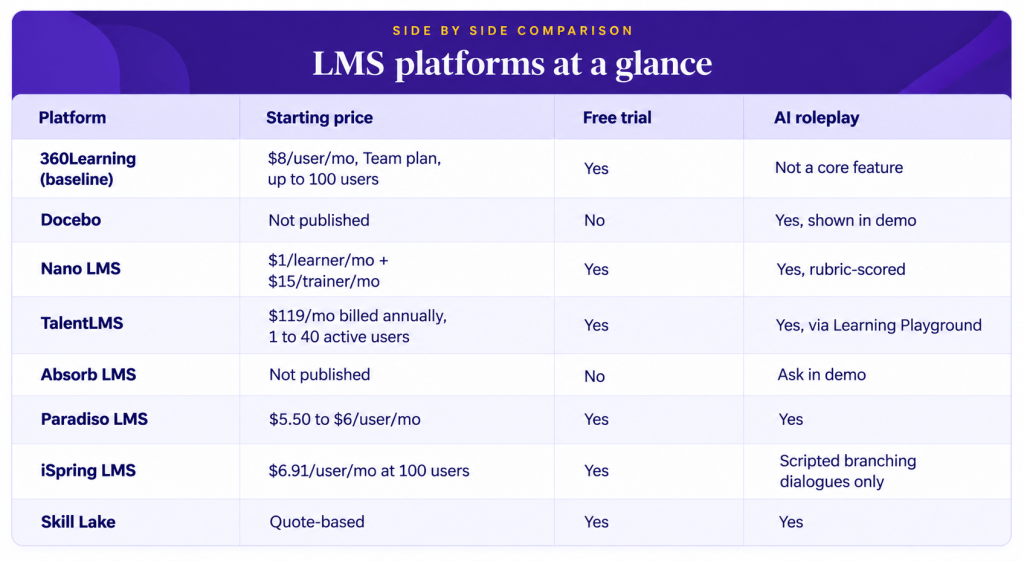
Prices pulled from each vendor’s own pricing page in September 2026, or flagged as unpublished where the vendor doesn’t disclose one.
Docebo: The extended-enterprise heavyweight
Docebo is the name almost every enterprise shortlist starts with, and the reputation is earned.
It was built for the extended enterprise: employees, partners, and customers trained from one platform instead of three, and by most reviewer accounts it delivers the strongest enterprise experience.
But the real question is whether you actually have three audiences. If you don’t, you’re paying for a lot of platforms you’ll never use.

Where it wins
- Mature multi-audience setup, with separate branded portals for each group.
- Deep admin controls and customization for teams that need tight governance.
- Native AI tooling across content creation and practice, including roleplay.
Where it hurts
- No published price. Two quote-based plans, Elevate and Enterprise.
- No self-serve trial, you see the product through a sales demo.
- Built for organizations with a dedicated LMS admin, which small teams feel quickly.
Best for: large, multi-audience programs with admin headcount and budget to match.
Pricing: Not published. Third-party estimates vary widely, and several put entry contracts in the tens of thousands per year.
Nano LMS: creation and practice, not just delivery
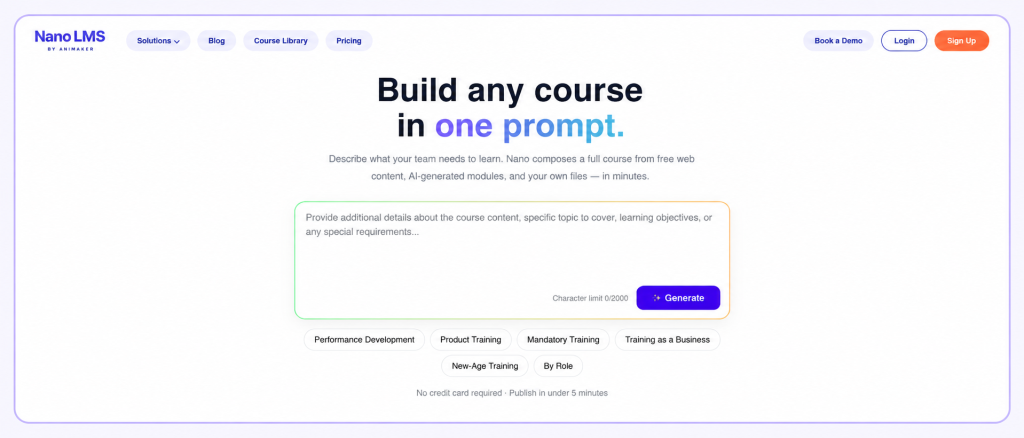
Most platforms on this list started as a place to host courses and added AI along the way. Nano LMS started with AI and built the LMS around it. That shows where it’s strongest: getting a course built in minutes, then making people practice it until you can see whether it worked.
Where it wins.
- Describe what people need to know, or upload the docs you already have. Nano LMS drafts the course, the scenario, and the assessment in minutes.
- AI roleplay adapts to what the learner actually says and scores against a rubric you define.
- Trainer and learner seats are priced separately. Fifty people taking a course don’t cost what two people building it do.
Where it hurts.
- Not built for co-authoring at hundreds-of-contributors scale.
Best for: teams without a dedicated LMS admin who need to prove a behavior changed, in sales, frontline service, healthcare, and compliance.
Pricing: Free tier, then $1/learner/mo + $15/trainer/mo.
TalentLMS: The fastest self-serve start
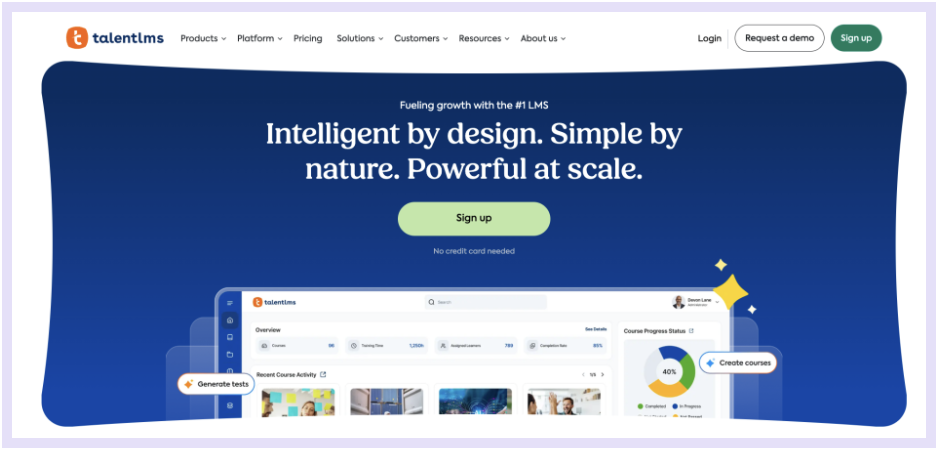
TalentLMS is the LMS people pick when they don’t want to talk to anyone, and that’s a compliment. It has published pricing, a free plan that never expires, and a working portal the same afternoon. Just know what happens to the bill when you grow.
Where it wins.
- The free plan (5 users, 10 courses, no time limit) is enough to build something real before you decide.
- TalentCraft generates courses from a topic or idea.
- Learning Playground adds Role Play, Simulation Mode, Practice Mode, and Learn Anything for practice outside formal courses.
Where it hurts.
- Pricing moves in user brackets (40, 70, 100), so growth means plan jumps.
- Everything above 100 users goes to a quoted Enterprise plan.
Best for: small, growing teams that want to be running today, without a sales call.
Pricing: From $119/mo for up to 40 users, billed on monthly active users rather than every account ever created.
Absorb LMS: sales-led, enterprise-built
Absorb LMS is what you buy when you’ve got four training programs on four different tools and a CFO asking why. It’s built to consolidate HR, compliance, sales enablement, and customer training onto one platform. The catch is that there’s no published price, so you won’t see a number until you’ve sat through a sales call. If you’re still comparing options, that makes Absorb hard to line up against anything else on this list.

Where it wins.
- Real breadth: one system can replace several point tools.
- Per-learner annual pricing that gets cheaper per head as volume grows.
Where it hurts.
- Pricing, feature access, and even a rough estimate all start with a sales conversation.
- Quote-only pricing makes budgeting and side-by-side comparison slow.
Best for: mid-market and enterprise teams consolidating multiple training programs into one system.
Pricing: Not published. Third-party spend trackers put average annual cost around $14,000 for a small team up to $80,000+ at enterprise scale.
Paradiso LMS: the LMS-plus-authoring combo
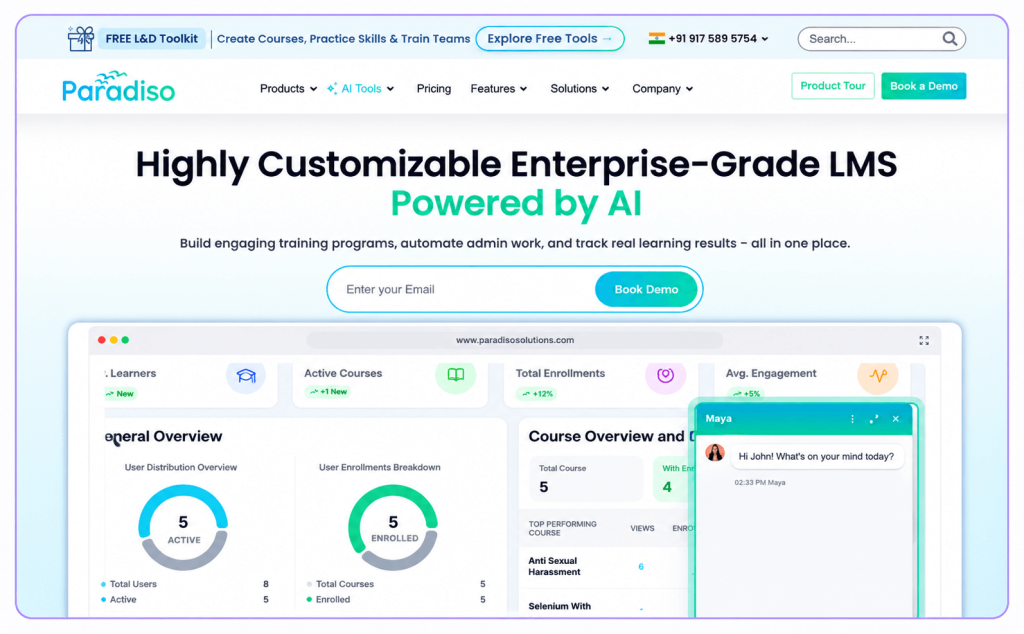
Paradiso tries to be three products at once: an LMS, a course builder, and a storefront for selling courses. For some teams that’s exactly the right bundle. For others it’s two more products than they needed, so it’s important for you to know which team you are before the demo.
Where it wins.
- Course creation, hosting, and course sales in one product means fewer tools to manage.
- A long AI feature list, including a course creator, roleplay, AI tutor, and translation into 100+ languages.
- A free version for up to 50 users.
Where it hurts.
- A product doing three jobs rarely goes as deep as a specialist on any one of them. Test the part you care about most.
Best for: teams that want the LMS and the course builder in one product.
Pricing: From roughly $5.50-$6/user/mo depending on billing frequency, with a free trial covering up to 50 users.
iSpring Learn: built for the PowerPoint workflow
iSpring’s LMS is the second-best thing iSpring makes. The real product is the authoring suite that turns PowerPoint slides into interactive courses, and the LMS is where those courses end up. If your team already lives in PowerPoint, that’s a genuine advantage. If it doesn’t, most of the appeal goes away.

Where it wins.
- The smoothest authoring-to-publishing path on this list if your designers already work in PowerPoint.
- The AI course generator now drafts courses inside the LMS.
- Per-user rates fall as you add seats.
Where it hurts.
- The desktop authoring tool, iSpring Suite, is Windows-only. Mac teams need the browser-based iSpring Cloud AI.
- Role-plays are scripted branching dialogues built in TalkMaster, with no open AI conversation.
- Authoring is licensed separately, from $970 per author per year.
Best for: onboarding and compliance programs built by a team that already lives in PowerPoint.
Pricing: $6.91/user/mo at 100 users, the smallest plan the vendor discloses, with a 30-day trial.
Skill Lake: Roleplay bundled with HR extras
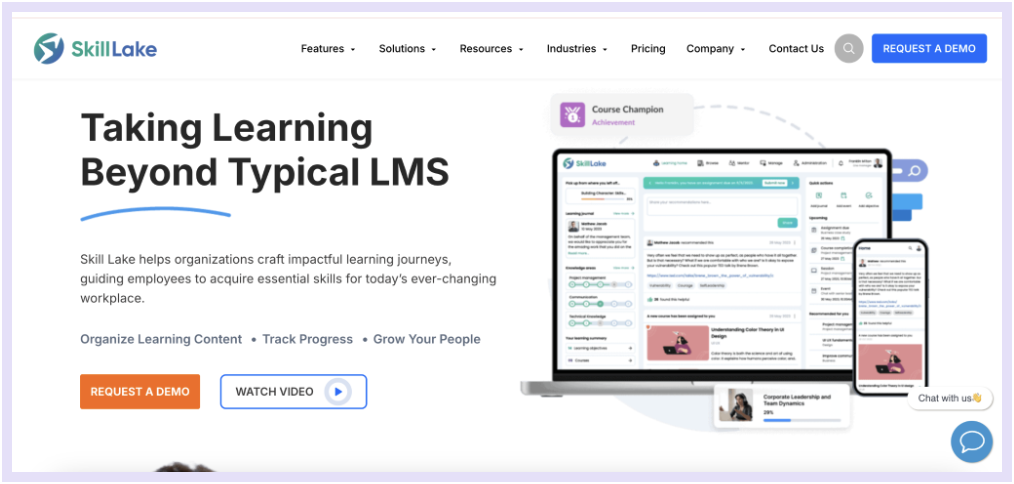
Skill Lake is the least-known name on this list, with one of the longest feature lists. It’s built by Fingent, a software company around since 2003, and it pitches itself as a full people-development platform with an LMS inside. That’s ambitious, and it means you’ll need more time to evaluate it than anything else here.
Where it wins.
- AI and ML-driven course recommendations, AR/VR content, competency mapping, and gamification all live under the same product
- A separate 360-degree performance-review module comes bundled in
- White-labeling and multiple hosting options for teams that need it
Where it hurts.
- No published pricing, and far less independent review data than the bigger names have.
- A platform doing this much takes longer to evaluate than one built for a single job. Get a written quote early.
Best for: teams that want roleplay practice wrapped into a broader performance and engagement suite.
Pricing: Not published on the vendor’s own site. Third-party listings put entry cost around $1/user/mo, unconfirmed by the vendor, with a free trial attached.
The three questions that actually decide this…
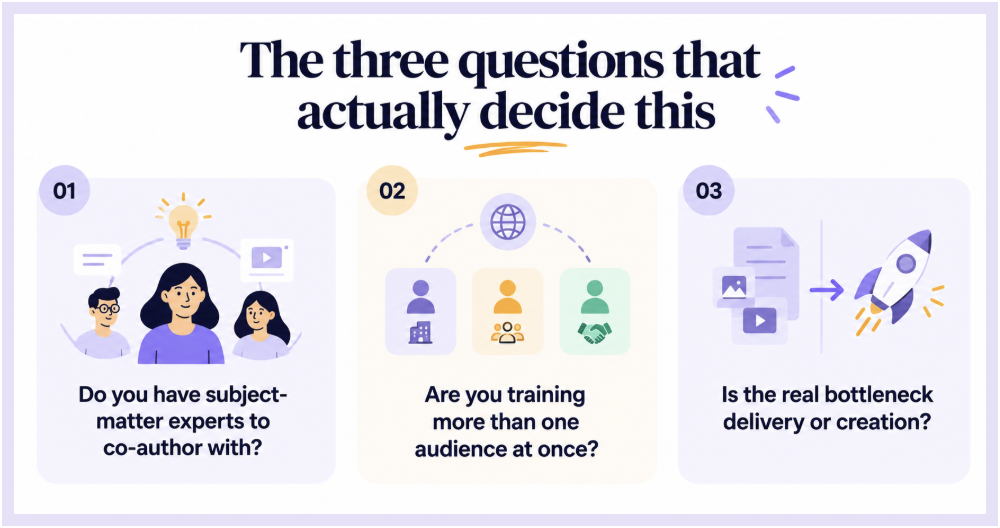
1. Do you have subject-matter experts to co-author with?
Dozens of people building content together is 360Learning’s whole model. One or two people building for everyone else means that model is working against you.
2. Are you training more than one audience at once?
Employees, partners, and customers together points at Docebo or Absorb. A single internal audience doesn’t need that machinery.
3. Is the real bottleneck delivery or creation?
A catalog that already exists just needs somewhere better to live, any of the six alternatives will do that job. A course that doesn’t exist yet is what Nano LMS is built to solve first.
None of this means you have to switch anything, either. If you’re mid-contract with 360Learning, or your compliance records sit somewhere you’d rather not disturb, the lower-risk move is to keep the existing LMS for the catalog and records, and add Nano LMS for scenario practice on the roles where a wrong answer actually costs something: sales, frontline, and compliance.
So which should you actually pick?
- Pick Docebo or Absorb if you’re training employees, partners, and customers together and you have the admin headcount to run it.
- Pick TalentLMS if you want the cheapest, fastest self-serve start and can live with a roleplay experience that’s still catching up.
- Pick iSpring or Paradiso if your team already builds in PowerPoint, or you want the course builder and the LMS in one product.
- Pick Skill Lake if you want roleplay bundled with gamification and performance review, and you have time to evaluate a broader platform.
- Start with Nano LMS if the real problem is getting good training built and practiced fast, not administering a catalog someone else already filled. It’s the only one on this list you can try free today, with a real course built before your next meeting.
Want the fast path? Start Nano LMS free, build a course from a document you already have, and run your team through an AI roleplay before you’ve booked a single sales call.
FAQ
1. What’s the best 360Learning alternative?
Depends on the job. Enterprise, multi-audience training points at Docebo or Absorb. A fast self-serve start points at TalentLMS. Proof that a behavior actually changed points at Nano LMS.
2. Does 360Learning have a free plan?
No, just a 30-day trial of its Team plan. TalentLMS and Nano LMS both have free tiers among the alternatives here.
3. Do I have to replace 360Learning to add AI roleplay practice?
Not always. Many teams keep their existing LMS for the catalog and records, and add Nano LMS for scored practice on the highest-stakes roles first.
4. How much does 360Learning cost compared to the alternatives? 360Learning’s Team plan runs $8 per user a month for up to 100 users, with Business and Enterprise quoted on request. Among the seven here, TalentLMS starts at $119/mo, iSpring Learn publishes $6.91/user/mo at 100 users, Paradiso runs $5.50-$6/user/mo, and Nano LMS is $1/learner/mo plus $15/trainer/mo after a free tier. Docebo, Absorb, and Skill Lake don’t publish a number on their own site.
5. Which of these has the strongest AI roleplay?
Based on what’s actually testable in a self-serve trial, Nano LMS and Paradiso are the two you can try yourself today. Docebo’s roleplay looks strong but only surfaces in a guided demo, TalentLMS’s felt rough in testing, and iSpring doesn’t have one at all.