
Rethinking Blended Learning: Why Programs Should Be Designed Around Practice?
Ask any L&D team how they build a training program and you will hear a familiar recipe: online modules first, a live session in the middle, an assignment at the end. For more than twenty years, that recipe has gone by the name blended learning, and it has become the default for corporate training.
The results tell an uncomfortable story.
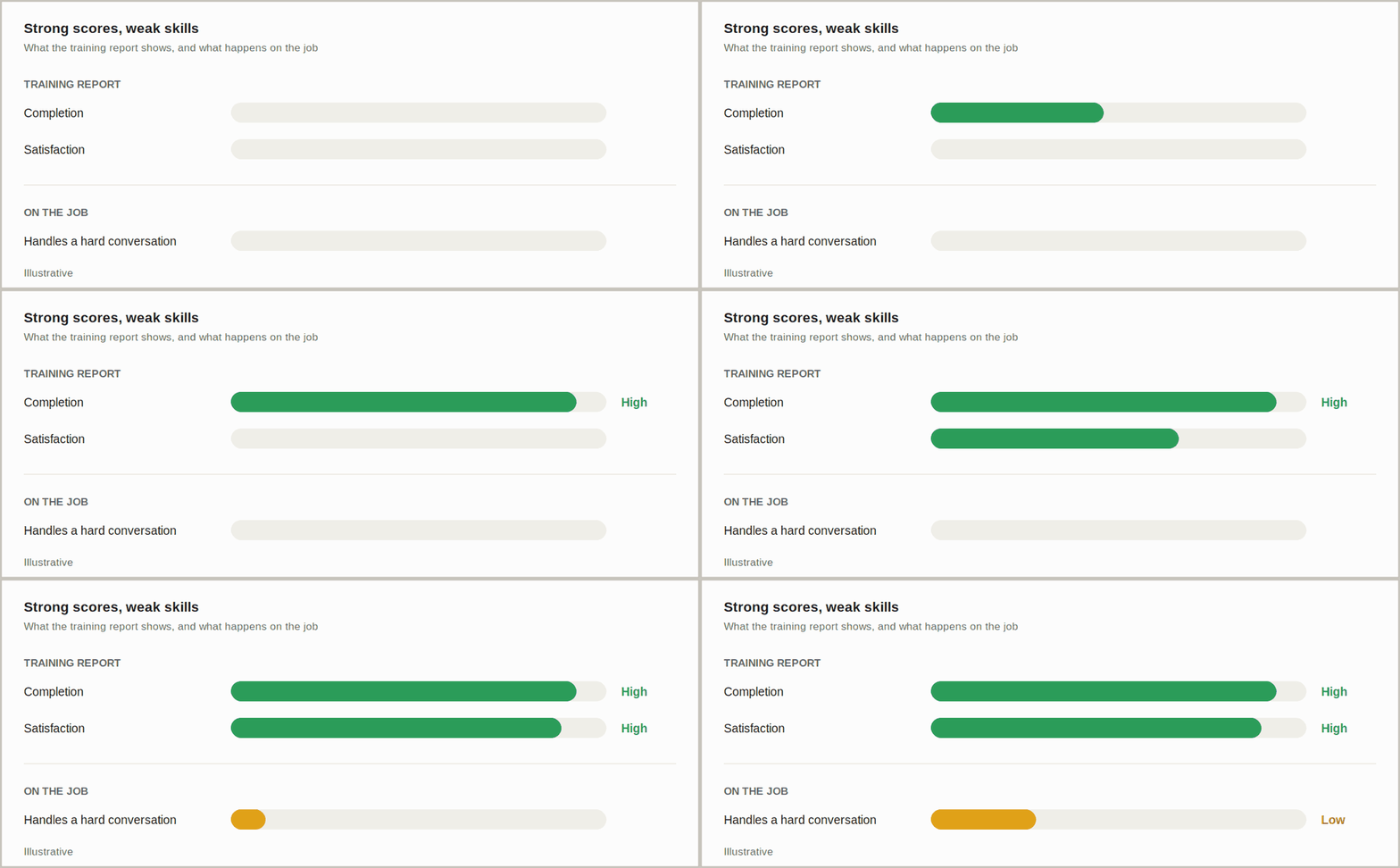
Completion rates look healthy, satisfaction scores are high, and yet new managers still freeze in their first difficult conversation, and sales reps still stumble over objections they were trained to handle.
The reason sits in the design. Blended learning decides where training happens: online, in a room, on a video call.
It rarely decides how often people practice the actual work and hear how they did. That was understandable when every practice attempt needed a trainer in the room, and trainers were expensive.
AI has changed that because practice with feedback can now happen at scale, at any hour, without a trainer for every attempt.
The way most blended programs are built is due for a rethink. To see why, start with what blended learning actually is, and how it ended up this way.
What does blended learning actually mean?
Blended learning is a training approach that combines self-paced online learning with live instruction, delivered in person or virtually, inside a single program. The online parts usually carry the knowledge, and the live parts carry discussion, application and questions.
In corporate L&D, it usually shows up in one of three forms:
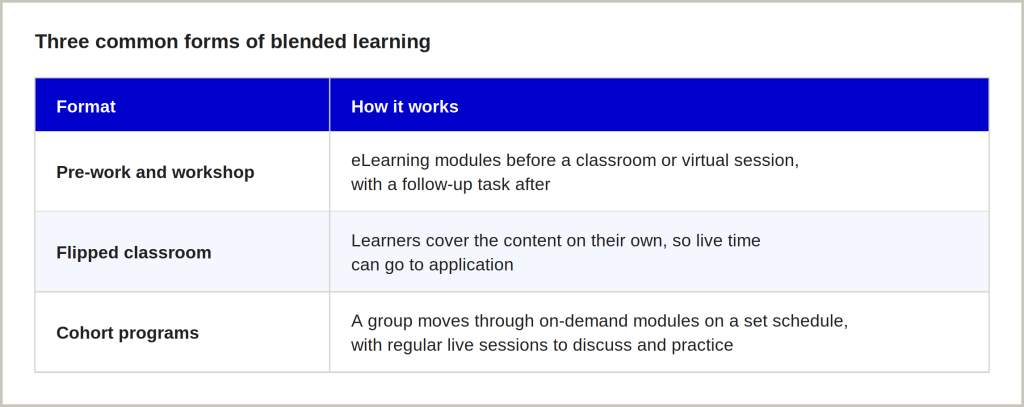
All three describe a program by its delivery channels. None of them says how often learners practice the actual skill, or who tells them how they did.
That gap is what the rest of this piece is about.
How the blend got built
Blended learning spread through corporate training for practical reasons. Classroom days were expensive, flights, hotels and lost productive hours added up fast, and eLearning offered a way to move the information part of a course onto a screen.
So teams split programs along a simple line:
- Anything that could be read or watched went online.
- Anything that needed a facilitator stayed live.
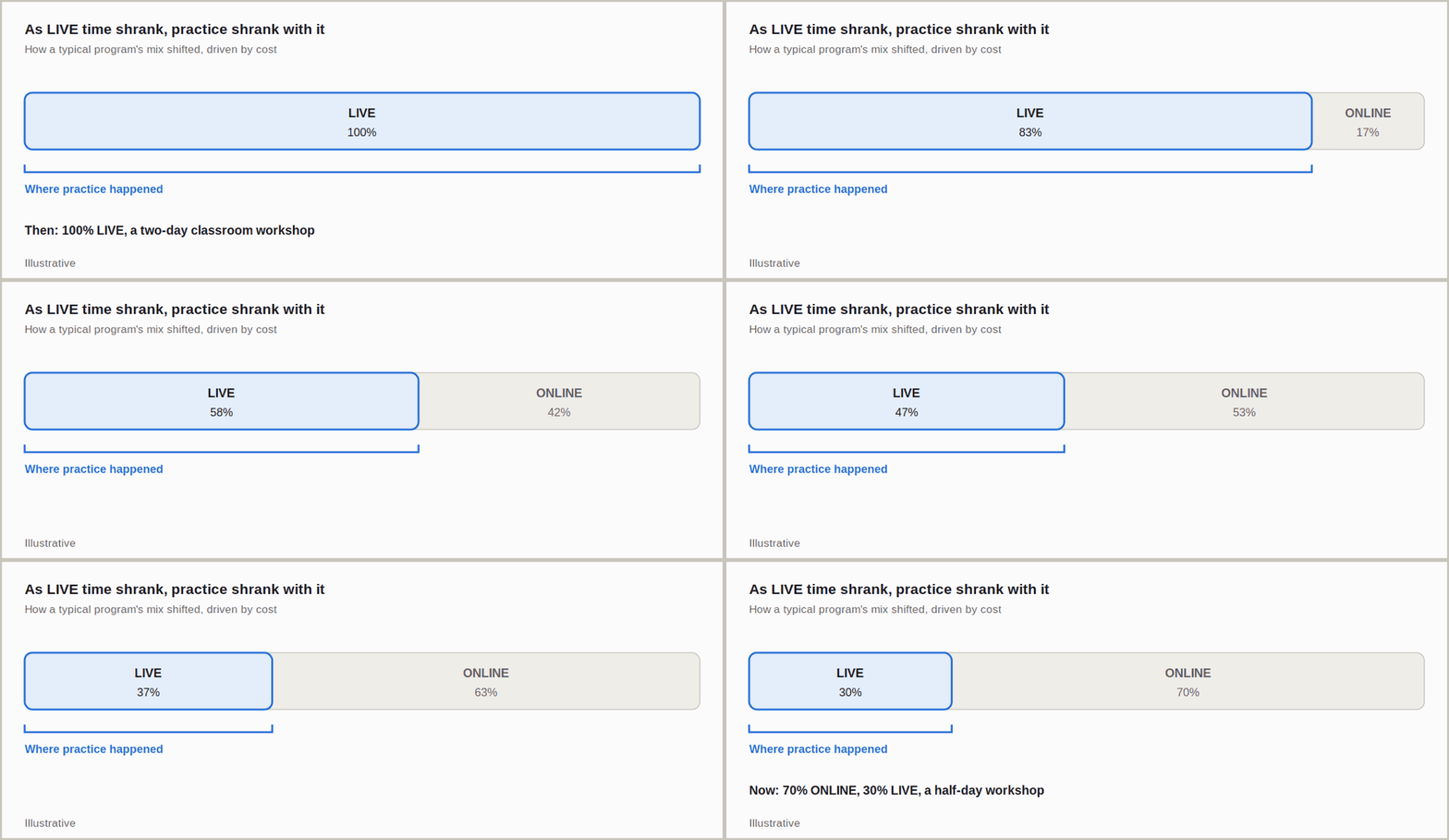
The live portion kept shrinking, because every hour of it cost more than every other hour in the program.
The ratios that resulted, 70% self-paced and 30% live, or a two-day workshop reduced to a half day, were rarely the product of a learning analysis. They were the product of a cost model. Most L&D leaders reading this have sat in the meeting where that trade was made.
Nobody did anything wrong here. Facilitator time was the only reliable source of practice and feedback, and it was scarce. The blend was a rational way of rationing it.
Where practice actually happens?
Take a typical four-week training program for new managers. On paper, it looks complete.
Now look at what the learner actually does each week:
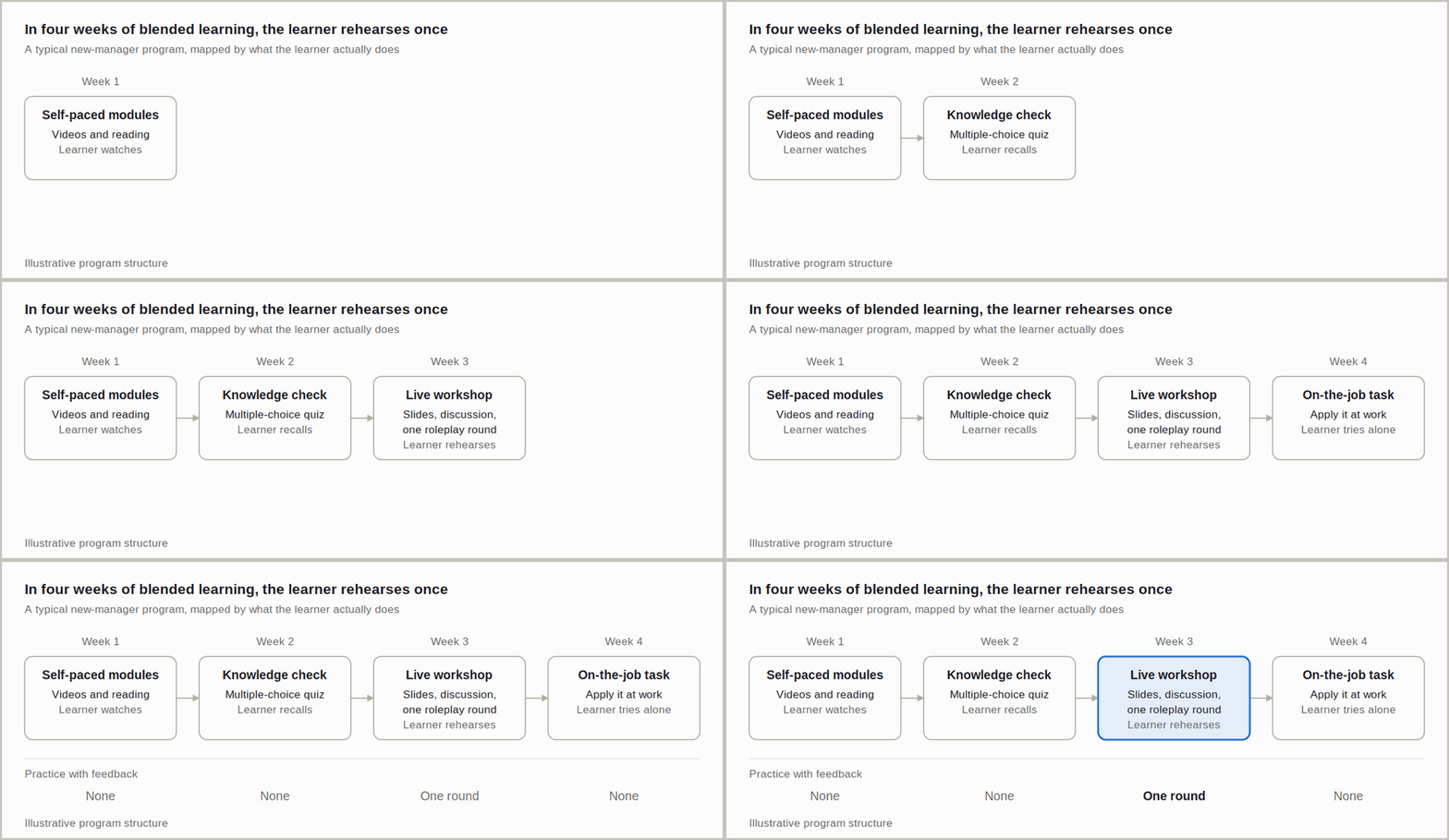
In a whole month, the learner practices the real skill once. That one roleplay often happens in front of colleagues, with only a few minutes of feedback.
This is why a program can get great completion rates and good reviews, while the people who took it still struggle the first time they have to use the skill for real.
They learned about the skill. They never got enough practice doing it.
Why practicing once isn’t enough
That single roleplay has another problem. Memory research has shown for over 140 years that people forget most of what they learn very quickly, unless they use it again.
Memory research has a clear answer to what happens when you learn something once and don’t use it again.
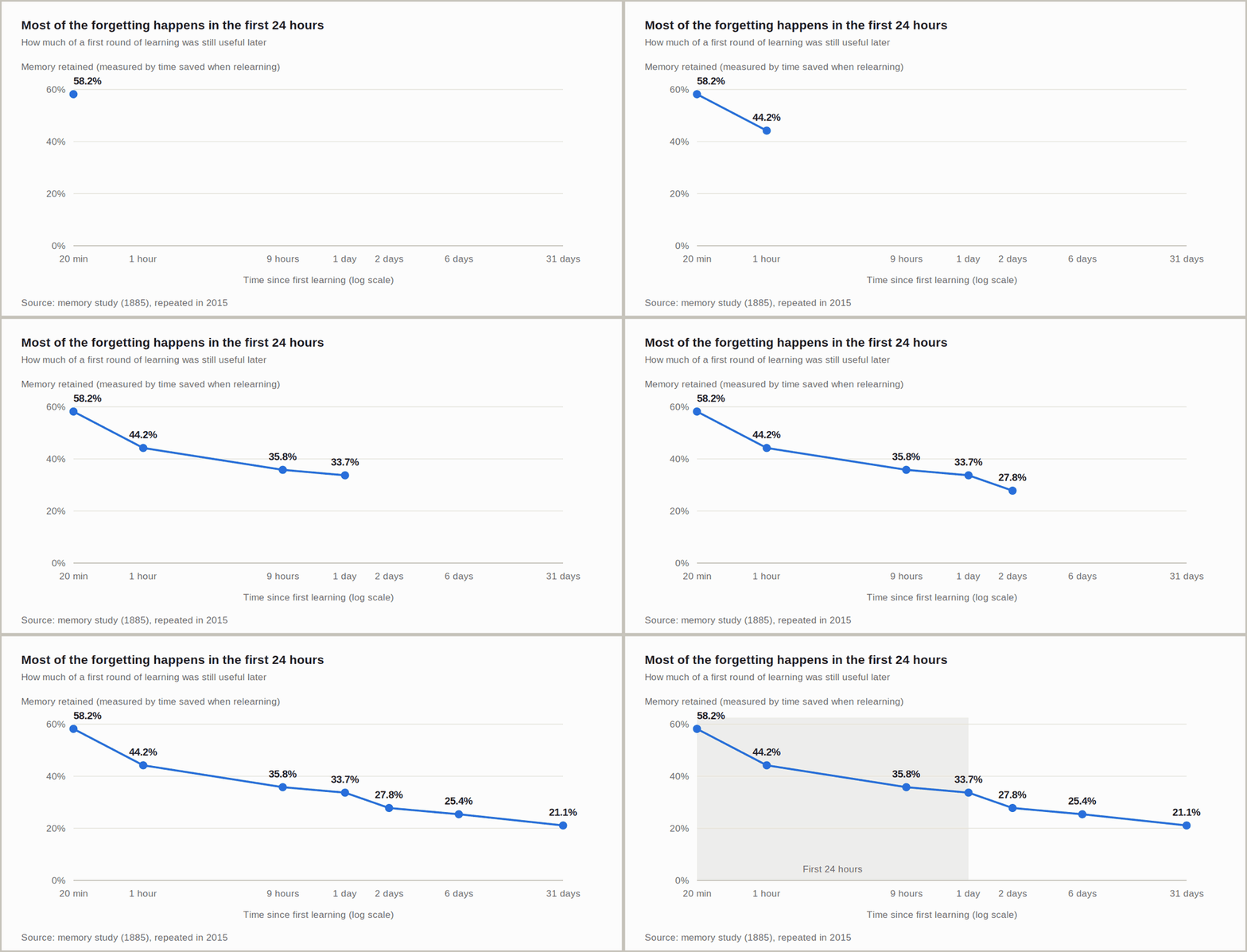
In a well-known memory study from 1885, a researcher learned lists of made-up words, then checked how much he still remembered after 20 minutes, a day and up to a month. Most of the forgetting happened in the first day. When researchers repeated the study in 2015, they got almost the same curve.
Made-up words are very different from workplace skills, so don’t read too much into the exact numbers. The pattern is what matters: people forget fast, unless they use what they learned again.
Two proven principles follow:
- Spaced practice: practicing a little over several days works better than practicing a lot in one sitting.
- Active recall: doing or recalling something strengthens memory more than rereading or rewatching it.
A program with one roleplay in week three uses neither.
What AI changed, and what it didn’t
Every blended program is built from three things: content, practice with feedback, and expert time.
AI has made the first two much cheaper. The third hasn’t changed.
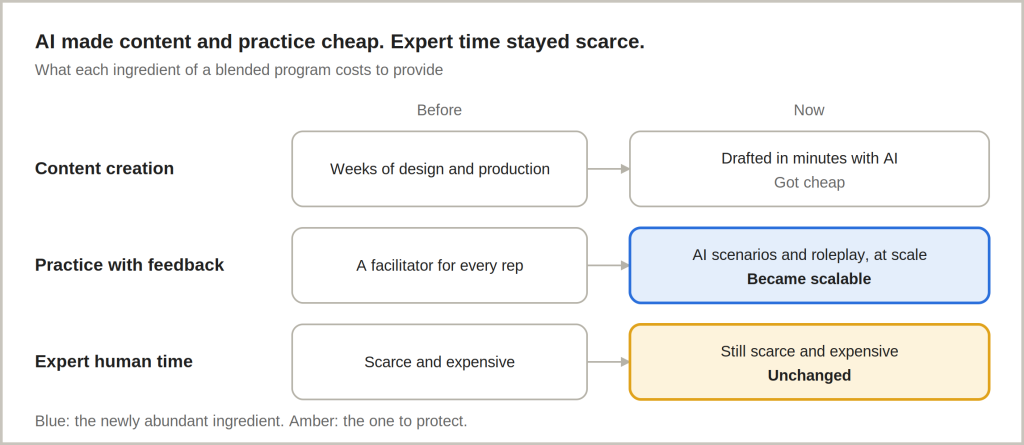
- Content got cheap: A course that took weeks to build can now be drafted in an afternoon. This gets the most attention, and it matters least. Most programs already had more content than people could absorb.
- Practice became scalable: With branching scenarios and AI roleplay, a learner can practice handling a sales objection, a safety situation or a feedback conversation ten times in a week, at any hour, and get feedback every time. That used to need a trainer for every attempt.
- Expert time stayed scarce: A good coach reading the room, a manager sharing real experience, a group building trust: none of that got cheaper. Expert time is now the most valuable part of any program, and the one to plan around.
Example: Aviation figured this out almost 100 years ago
Pilot training faced the same problem and solved it.
In 1929, one of the first flight simulators was built: a wooden cockpit that tilted and rolled as the pilot moved the controls. For its first few years, it was used in a small flying school and sold to amusement parks as a ride.
Then, in 1934, the US Army lost twelve pilots in 78 days while flying mail routes, largely because they weren’t trained to fly using instruments alone. The Army ordered six simulators that year. By the end of World War II, more than half a million US pilots had trained on them.
Pilot training still follows the same three-part design:
- Classroom training teaches the knowledge.
- The simulator is where pilots practice emergencies, as many times as they need.
- Instructors spend their time on debriefs and final checks.
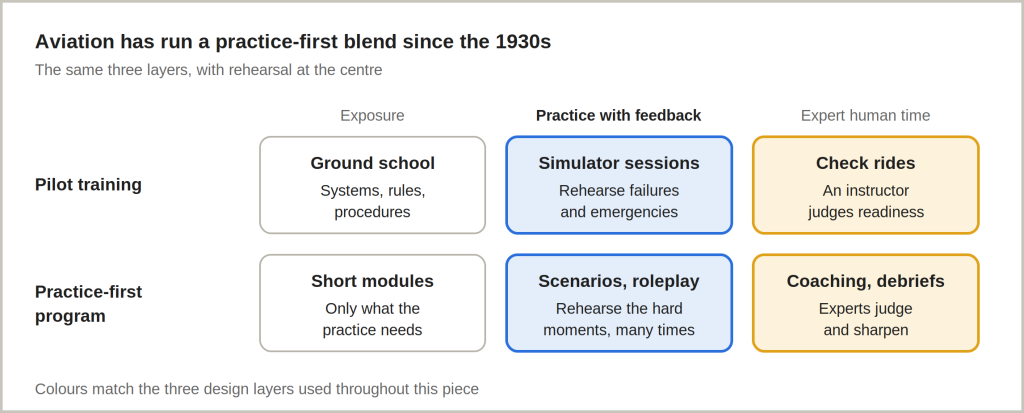
No airline would let a pilot fly passengers after reading a manual, watching a video and trying once with supervision. Yet that’s how most corporate training works, because practice used to be too expensive. That reason is disappearing.
A better way to design
The usual question is: how much of the program should be online, and how much live?
A better question: where will people practice, and what should trainers spend their time on?
Answering it means designing in a new order. Most teams start with content, add a workshop, and fit practice in wherever there’s space. Flip it.
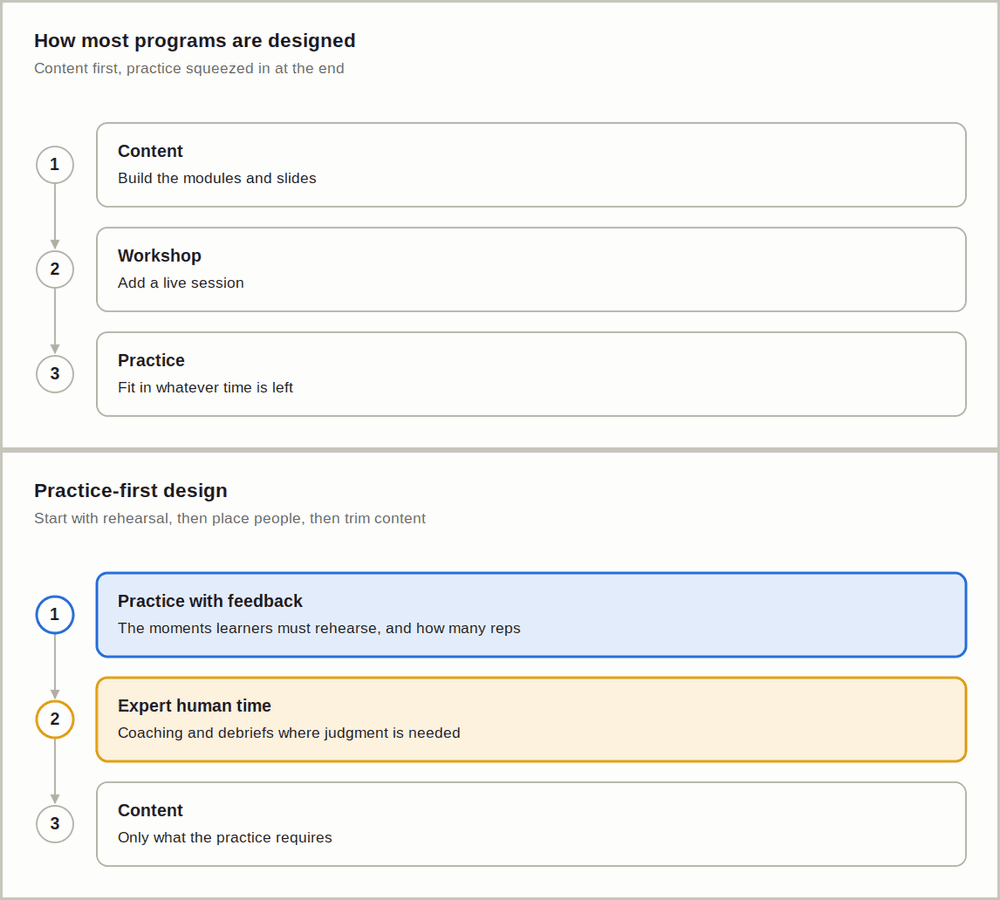
- Start with practice: List the moments learners must get right, like a new manager giving tough feedback, a sales rep handling a price objection, or a supervisor stopping an unsafe job. Decide how many practice rounds each one needs and how feedback will be given.
- Then add people: Use trainers, coaches and managers where judgment and trust matter most, mainly to review and discuss the practice.
- Add content last: Include only what people need for the practice. This is usually where programs can cut the most.
Track one number: the Practice Ratio
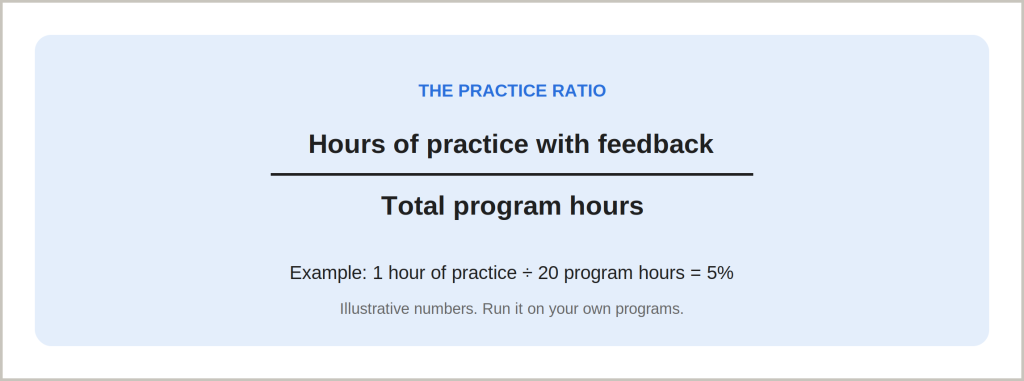
For the four-week example above, it comes to only a few percent. Try it on your own key programs before your next redesign. It’s a simple number, and that’s why it works: anyone in the room can see the gap, including whoever approves the budget.
What L&D leaders can do now
Three changes, and none of them need extra budget to start:
- Describe programs by practice: “60% online, 40% live” only tells people how the calendar looks. Say how many practice rounds each learner gets and who gives the feedback.
- Find where practice happens today: Pick your three most important programs and mark every moment where learners do the task and get feedback. Most teams find very few.
- Protect trainer time: Let AI scenarios handle the first rounds of practice, so live sessions can focus on where learners are struggling. Save expert time for judgment calls, debriefs and the conversations people won’t have with software.
There’s a measurement benefit too. Most training evaluation stops at “did they learn it?” The question that matters is whether people do the job differently afterwards, and practice is the most direct way to get there.
Where this leaves blended learning
Blended learning was a smart answer to a real problem: practice needed trainers, and trainers were expensive.
That problem is fading. At Nano LMS, it’s what we built around. Scenario-based learning and AI roleplay give every learner practice and feedback inside the program, so live time can go to coaching.
Whatever tools you use, start your next program with three questions:
- Where will people practice?
- How often?
- Who will give them feedback?
Plan the rest of the program around those answers.