
Cornerstone vs Docebo vs Workday: Which Enterprise LMS Actually Wins in 2026?
Let me save you a very expensive mistake.
Choosing between Cornerstone, Docebo, and Workday is not a software decision. It's a $70,000-a-year, three-to-twelve-month, hard-to-reverse commitment that your whole company will feel. Get it wrong and you're either migrating again in 18 months or explaining to finance why adoption is at 30%.
So this isn't a listicle. It's the honest breakdown of what these three platforms actually are, where each one wins, and the 2026 traps nobody puts in the sales deck. By the end you'll know exactly which one fits, or whether you should be looking at something else entirely.
Let's get into it.
TL;DR
Here's the truth most comparison pages bury: these three are not the same kind of product.
- Cornerstone is a full talent suite (learning + performance + recruiting + succession) with a very deep LMS inside it. Best for large, regulated, global enterprises that want the entire talent lifecycle in one place.
- Docebo is a best-in-class standalone AI LMS. Learning is the whole point, and its AI is the most mature in the category. Best for organizations that want the strongest learning platform and will handle HR elsewhere.
- Workday Learning is a learning module inside an HCM suite. It mostly makes sense if you already run Workday for HR and payroll, and it just got a massive AI upgrade by acquiring Sana.
- Nano LMS is the AI-native, creation-first LMS that actually builds the courses for you and lets people practice, and it starts free. Best for the mid-market, SMB, and L&D teams the enterprise three price out.
The one-line decision: Already on Workday HCM? Look at Workday first. Want the best pure learning-and-AI platform? Docebo. Need the entire talent lifecycle plus the deepest compliance? Cornerstone. Want AI-native course creation and practice without a six-figure contract or a six-month rollout? Nano.
And if you're not a 5,000-plus-employee enterprise, pay close attention to the Nano section, because all three of the big platforms might be the wrong answer for you.
The reframe that saves you months: they're not competing for the same job
Most buyers evaluate these three as if they're interchangeable. They're not, and confusing them is the single most common evaluation mistake.
- Buy Cornerstone and you're buying a talent management strategy. Learning is one pillar of many.
- Buy Docebo and you're buying the best possible learning experience, and integrating it with whatever HR system you already have.
- Buy Workday and you're buying learning that lives inside your system of record, so training data sits next to headcount, comp, and performance automatically.
Get clear on which of those three jobs you're actually hiring for, and the decision gets dramatically simpler. Now the deep dives.
Side-by-side at a glance
| Nano LMS AI-native, creation-first | CornerstoneTalent suite + LMS | DoceboStandalone AI LMS | Workday LearningHCM learning module | |
| What it is | AI-native, creation-first LMS | Talent suite + deep LMS | Standalone AI LMS | Learning module in HCM suite |
| Core strength | Builds the courses for you + built-in practice | Full talent lifecycle + compliance | Best-in-class learning AI + UX | Unified with HR system of record |
| AI direction | AI course creation + AI Roleplay/sims | Galaxy Skills Graph | AI Author, Discover Coach, Shape | Now supercharged by Sana |
| Best for | SMB, mid-market, L&D teams, fast movers | Large regulated global enterprise | Learning-first orgs, extended enterprise | Existing Workday HCM customers |
| Pricing | Free tier, then affordable paid | Custom, ~$69K/yr avg | Custom, ~$7–10/user/mo + AI uplift | Custom, bundled into Workday |
| Free tier | Yes | None | None | None |
| Implementation | Minutes to first course | 3–12 months, complex | Faster than Cornerstone | Tied to Workday rollout |
Cornerstone OnDemand: the enterprise talent behemoth
Cornerstone has been around since 1999, and it shows, in both good ways and bad.
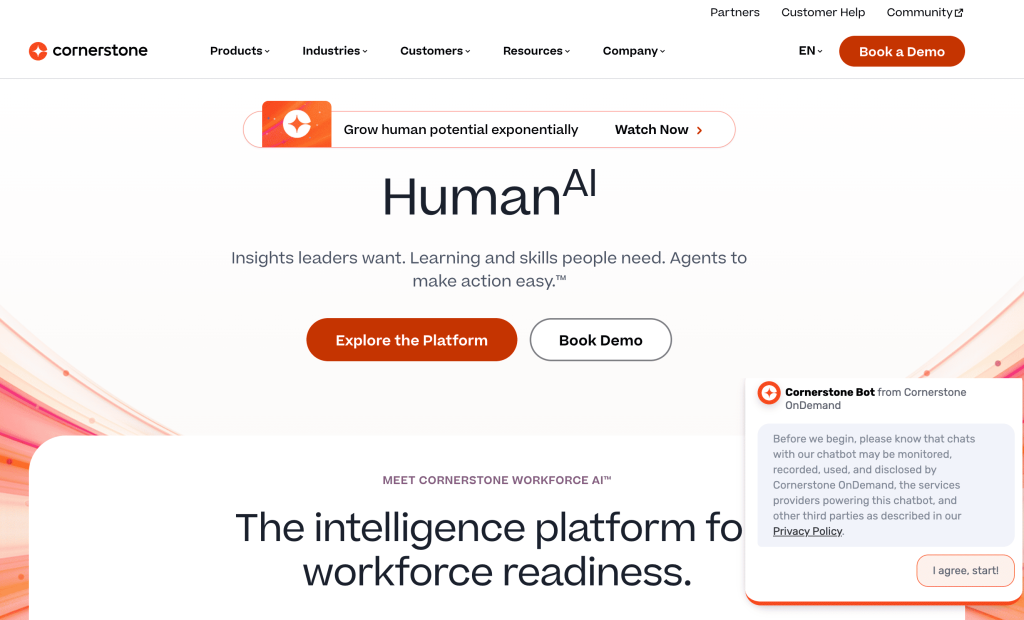
Where it wins. Cornerstone is the broadest platform of the three. It combines learning with performance management, recruiting, and succession planning in one talent suite, which no standalone LMS matches. Its compliance depth is genuinely best-in-class: automated enrollment, recertification, audit trails, and regulatory reporting that heavily regulated industries (finance, healthcare, pharma, government) rely on. Its Content Anytime marketplace bundles 4,000-plus courses from LinkedIn Learning, Coursera, and Pluralsight. And its Galaxy AI Skills Graph maps organizational competencies to learning and career paths. If you want learning, performance, and succession connected end to end, this is the deepest option on the market.
Where it hurts. The user interface is dated, implementation is complex (plan for 3 to 12 months), and the learning curve is steep. Pricing is enterprise-only and custom, with Vendr procurement data putting the average Cornerstone contract around $69,000 a year. It's a weak fit for SMBs and a stretch for mid-market teams who find it over-engineered for their needs.
The 2026 trap you must ask about. Cornerstone is consolidating its acquired products, Saba, EdCast, and Grovo, into Cornerstone Galaxy, and Saba reaches end-of-life in December 2026. Analyst firm Fosway rates Cornerstone's trajectory as "Evolving" and has noted that sunsetting acquired products has left some customers feeling abandoned. If you evaluate Cornerstone, ask exactly which product you're buying, what the migration path looks like, and what the Galaxy roadmap commits to in writing.
Best for: global enterprises of 5,000-plus employees in regulated industries that want the full talent lifecycle in one system and have the team to run it.
Docebo: the AI-native learning specialist
If Cornerstone is the suite, Docebo is the specialist. Learning is not a module here. It's the entire product.
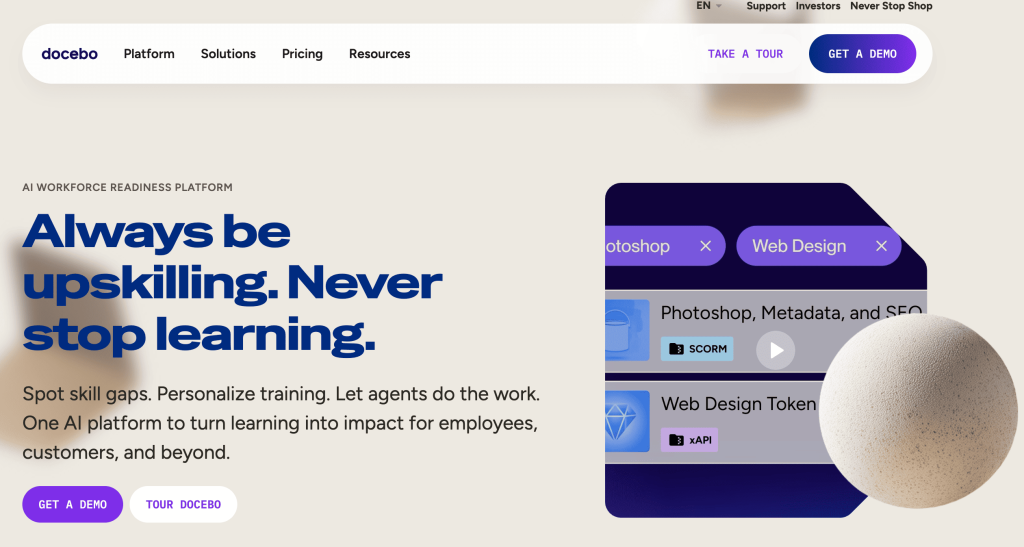
Where it wins. Docebo has positioned itself as the AI-native LMS, and it's earned it. Its AI is the most mature in the category: AI Author generates courses from source documents, Discover Coach gives learners conversational guidance, and Docebo Shape builds skills-based learning paths. The UX is modern, engagement is high, extended-enterprise support (training customers, partners, and franchisees from one platform) is strong, and it integrates cleanly with Workday, Salesforce, Slack, and Teams. It picked up 2026 recognition for practical AI and frontline learning, and, importantly, its roadmap is clean. No messy platform consolidation, no product sunsets forcing customers to migrate.
Where it hurts. Docebo is learning-only. It does not include performance management, recruiting, or succession planning, so if you need those, you're integrating other tools. Pricing is custom, with Vendr data suggesting roughly $7 to $10 per active user per month for the base Learning Suite, and the AI tier carries a 15 to 30 percent uplift. It loses to Cornerstone on the very deepest compliance workflows, loses to Workday when the buyer already pays for Workday HCM, and loses to SMB-friendly tools on price for sub-200-employee teams.
Best for: medium-to-large organizations that treat learning as a priority, want the best AI and UX, and are happy to run HR in a separate system.
Workday Learning: the system-of-record play (now with Sana)
Workday Learning is the odd one out, and understanding why is the key to the whole comparison.
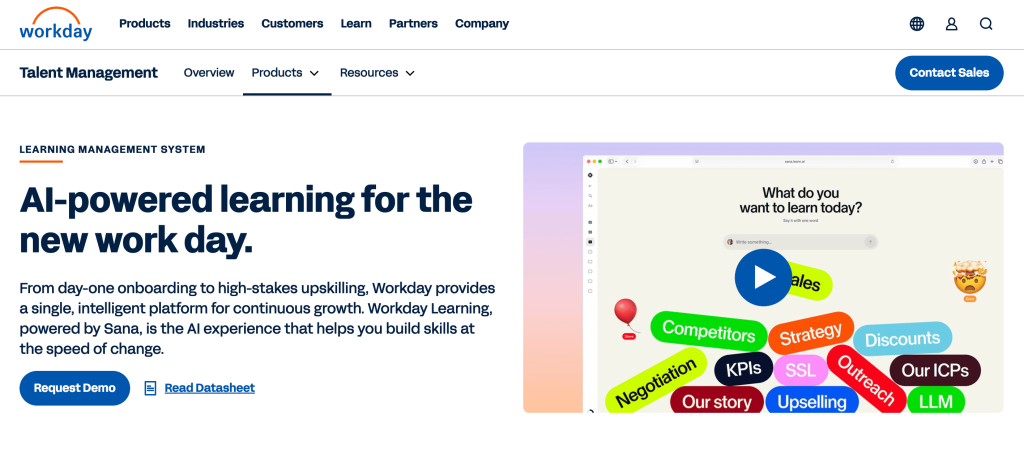
Where it wins. Workday Learning isn't really sold as a standalone LMS. Its power is that it lives inside Workday's HCM suite, on a single data architecture with HR, payroll, and finance. For an organization already running Workday, learning data sits natively next to headcount, skills, comp, and performance, and the incremental cost of adding Learning is small relative to a net-new deal with another vendor. That gravity is the entire value proposition.
The 2026 game-changer. Historically, Workday Learning's own AI was considered grafted-on rather than designed-in. That changed. Workday acquired Sana for approximately $1.1 billion (announced September 2025), to build what it calls "the new front door for work," folding Sana's AI-native learning, search, and agents into the Workday platform. Overnight, Workday went from having a basic LMS to owning one of the most advanced AI learning teams in the market. If you're a Workday customer, this is a big deal worth watching closely.
Where it hurts. Outside the Workday ecosystem, it makes little sense. It's enterprise-only, bundled and expensive, and learning is secondary to the HCM story. And the Sana integration is still landing, so some of the promised magic is roadmap, not reality, today.
Best for: existing Workday HCM customers who want learning inside their system of record and are willing to bet on the Sana integration maturing.
Nano LMS: the AI-native challenger built for creation and practice
The three platforms above are all, at their core, sophisticated systems for delivering content you still have to produce somewhere else. Nano attacks a different problem: the one that actually stalls most training programs.
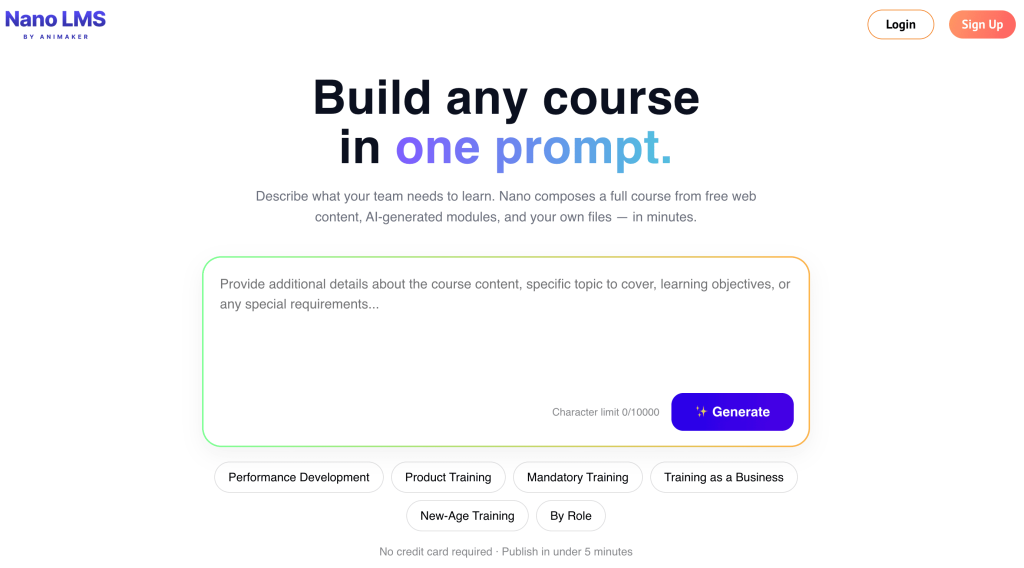
Where it wins. Nano is creation-first. Instead of you spending three hours building a course in a separate authoring tool, you describe what you want trained, or point Nano at a PDF, a slide deck, or a recorded call, and it drafts a full multimedia course, structure, video lessons, quizzes, and a certificate, in minutes. Then you edit. That collapses the single biggest bottleneck in L&D: getting subject-matter knowledge out of busy experts' heads and into finished training.
Then it does the thing most LMSs never touch: practice. Learners don't just watch a lesson on handling an objection or a difficult conversation, they rehearse it against an AI through roleplay and scenario simulations, and get scored, before it counts on a real call. That's genuine behavior-change training, not passive completion.
And it starts free, no procurement cycle, no six-figure contract, no permission needed. It's video-first (built by the Animaker team, trusted by 35M-plus creators), supports 90-plus languages, and is independent, so your learning platform isn't a feature of someone else's HR suite or acquisition strategy.
Where it's honest about limits. Nano is the newer name here, and it is not trying to be Cornerstone's compliance-and-succession suite or Workday's HCM system of record. If you're a 20,000-person bank that needs audit trails wired into a full talent lifecycle, buy the enterprise suite. Nano is closing the enterprise-readiness gap (SSO, admin, analytics) rather than headlining it.
Best for: SMBs, mid-market teams, and L&D departments of one that want to create and practice great training fast, and any organization where the real bottleneck is producing courses, not administering a catalog.
The 3 questions that actually decide this
Forget the feature checklists. This decision comes down to three questions.
1. Are you already on Workday HCM? If yes, evaluate Workday Learning first, purely on economics and data unity. If no, Workday drops off the list almost entirely. It's not worth adopting the HCM suite just to get the LMS.
2. Do you need the full talent lifecycle, or just learning? If you genuinely use performance, recruiting, and succession as one connected system, Cornerstone's breadth is the value. If learning is the job and you'll handle HR elsewhere, Docebo's depth wins, and many organizations happily run Docebo plus Workday as an alternative to Cornerstone's all-in-one approach.
3. Is your priority compliance depth or AI and UX? Heavily regulated, audit-heavy, global? Cornerstone's compliance engine is unmatched. Want the most modern, AI-driven, high-engagement learning experience? Docebo.
Answer those three honestly and your winner is usually obvious.
The elephant in the room: all three might be wrong for you
Here's what none of these three vendors will tell you.
Cornerstone, Docebo, and Workday are enterprise-only, custom-priced, RFP-gated, and slow to deploy. None offers a free tier. Vendr data puts enterprise LMS pricing in the $300 to $500 per user per year band. Implementations run months, not days. They are built for organizations with dedicated L&D teams, procurement cycles, and five-figure-plus budgets.
If that's you, great, pick from the three above. But if you're a mid-market company, an SMB, a fast-moving team, or an L&D department of one, all three are overkill and overpriced. You'd be buying a freight train to cross the street.
And there's a second problem even enterprises share: the bottleneck in training was never delivery, it was creation. Your subject-matter experts are busy. Building courses takes weeks. All three platforms are, at their core, sophisticated delivery systems for content you still have to produce.
That's exactly the gap Nano LMS fills, and it's why it belongs in this comparison even though it plays a different game: it creates the courses for you and lets people practice them, starting free, instead of charging six figures to administer a catalog you still have to fill. If your real problem is producing great training fast rather than running a giant compliance suite, the enterprise three are the expensive way to solve it.
So which should you actually pick?
- Pick Cornerstone if you're a large, global, regulated enterprise that wants learning, performance, recruiting, and succession in one deep suite, and you'll ask hard questions about the Saba end-of-life and Galaxy migration.
- Pick Docebo if learning is your priority and you want the most advanced AI and the best modern UX, with a clean roadmap and no consolidation drama.
- Pick Workday Learning if you already run Workday HCM and want learning in your system of record, and you're betting on the Sana integration paying off.
- Start with Nano if you're the mid-market, SMB, or L&D team these three price out, or if your core problem is creating and practicing training fast rather than administering a giant catalog. It's the only option here you can try free today and have a real course built before lunch, so there's almost no reason not to see it for yourself first.
The most expensive mistake in this category isn't picking the "wrong" one of the big three. It's buying a heavyweight enterprise suite to solve a problem a faster, lighter, AI-native tool would have solved in a fraction of the time and cost. Match the tool to the job. Then move.
Want the fast path? [Start Nano LMS free], build a course from a document you already have, and drop your team into an AI roleplay, all before you've booked a single enterprise demo.
Also Read: 20 best corporate LMS platforms
FAQ
What's the difference between Cornerstone, Docebo, and Workday? Cornerstone is a full talent suite with a deep LMS. Docebo is a standalone AI-powered LMS focused only on learning. Workday Learning is a learning module inside the Workday HCM suite. They solve different jobs, so the "best" depends on whether you want a talent suite, a learning specialist, or learning inside your HR system.
Which is the best enterprise LMS in 2026?For pure learning and AI, Docebo is a strong choice. For the full talent lifecycle and deep compliance, Cornerstone is a strong choice. For existing Workday HCM customers, Workday Learning is a natural option, strengthened by its Sana acquisition. For teams that want AI-native course creation and practice without enterprise pricing or a long rollout, Nano LMS is a creation-first alternative. There is no single winner; the best choice depends on your specific needs.
How much do Cornerstone, Docebo, and Workday Learning cost?
Cornerstone, Docebo, and Workday Learning are custom-priced and do not offer a standard free tier. Vendr data puts enterprise LMS pricing around $300 to $500 per user per year, with Cornerstone averaging roughly $69,000 per year and Docebo around $7 to $10 per active user per month plus an AI-tier uplift. Pricing varies based on users, features, implementation, and contract terms, so enterprise buyers typically need an RFP.
Is Cornerstone being discontinued?
No. Cornerstone is not being discontinued, but it is consolidating acquired products such as Saba, EdCast, and Grovo into Cornerstone Galaxy. Saba reaches end-of-life in December 2026. Organizations evaluating or already using Cornerstone should confirm the specific product being purchased and understand the applicable migration path.
What if I'm too small for Cornerstone, Docebo, or Workday Learning?
If you have fewer than a few thousand employees or want to get started without a lengthy procurement process, large enterprise LMS platforms may be more than you need. AI-native platforms like Nano LMS can offer faster course creation, built-in practice, and a free tier, making them a better fit for many mid-market and SMB teams.