
Manufacturing Training Hit $32 Billion. The Floor Still Feels Undertrained.
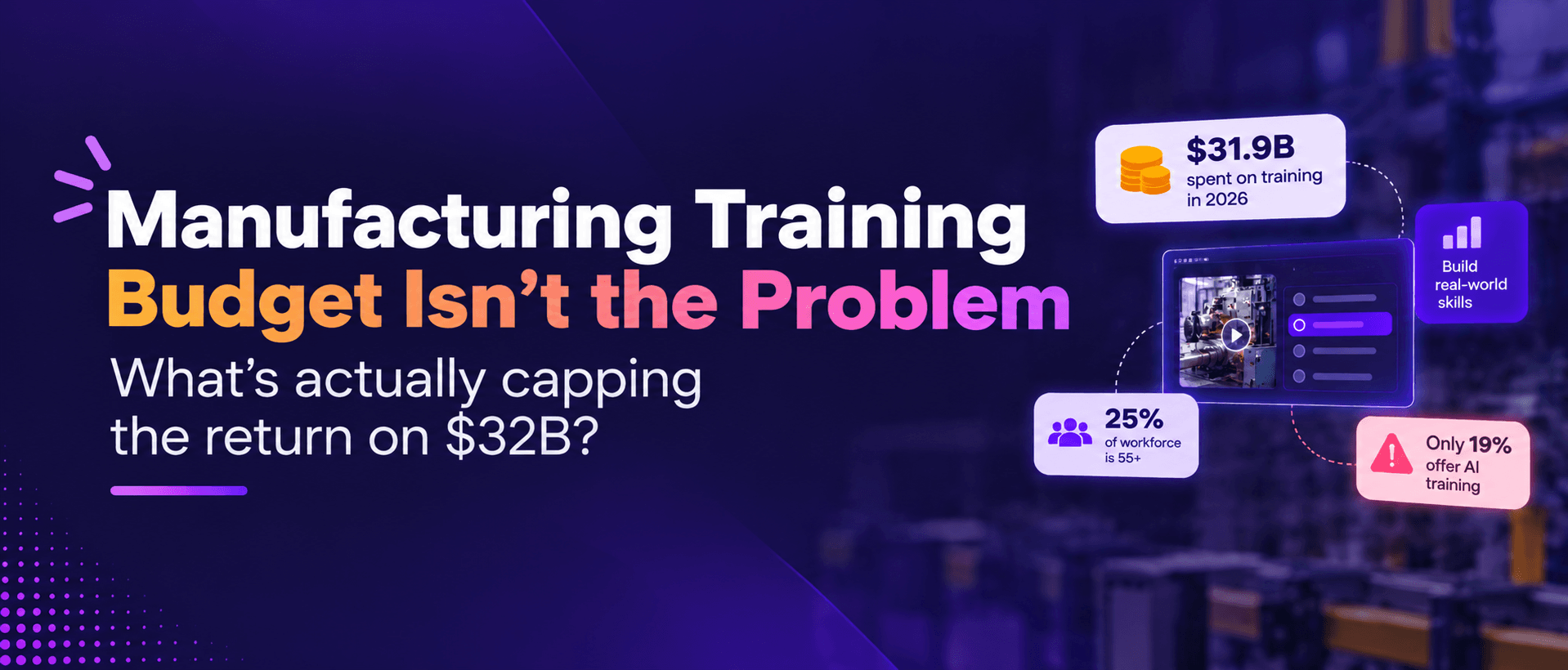
Let's start with a number that should feel like a win: $31.9 billion.
That's what U.S. manufacturers spent on training and upskilling in 2026, up 22% from $26.2 billion in 2019. If you run L&D for a plant, that's the budget line you'd have fought for a decade ago.
So here's the question nobody's asking loudly enough: if the money's finally there, why does the floor still feel undertrained?
I went digging through The State of Workforce Training in Manufacturing (April 2026) to find out. The answer wasn't where I expected.
Something is capping the return on that $31.9 billion.
What’s actually blocking the training? (hint: not just the budget)
Ask manufacturers what's stopping them from training more, and cost comes in third.
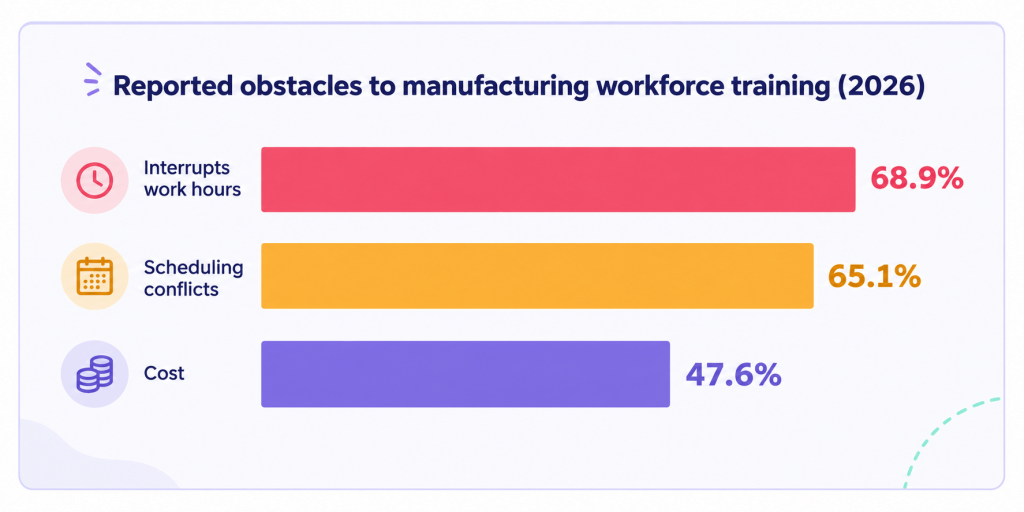
Two operational headaches beat cost by a wide margin: interrupted work hours and scheduling conflicts. Cost trails both.
Read that again.
Manufacturers aren't holding back the checkbook.
They're running classroom-clock training on a shift-clock workforce.
And every classroom hour gets paid for twice. Once for the training itself. Again for the output that stopped while someone sat through it. That second cost never shows up on a training budget line. It shows up on the production report, weeks later, as a dip nobody can quite explain.
This is exactly what short, on-demand scenario training closes the gap.
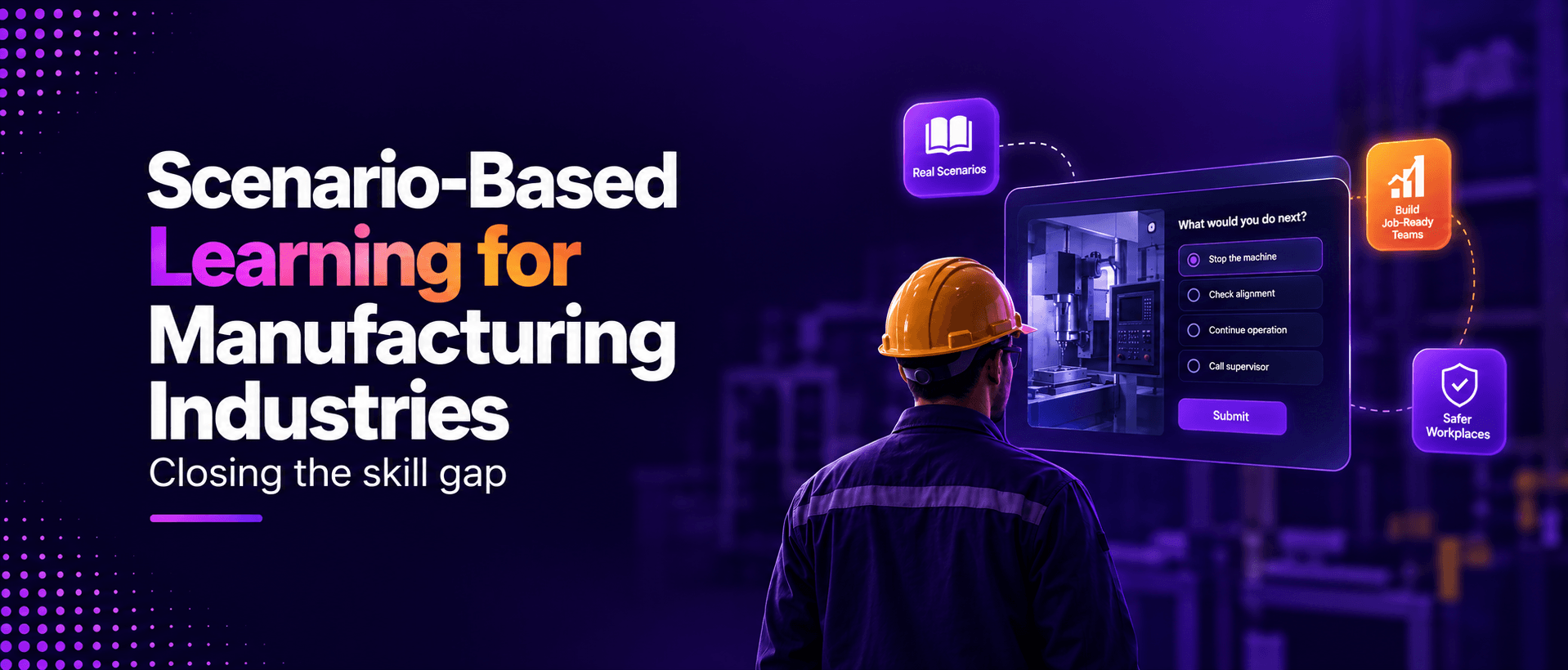
A ten-minute scenario a worker runs between shift tasks doesn't compete with the clock the way a scheduled classroom session does. That's the whole bet behind Nano LMS's scenario-based learning for manufacturing floors.
Speeding is up, momentum isn’t. And that should worry you.
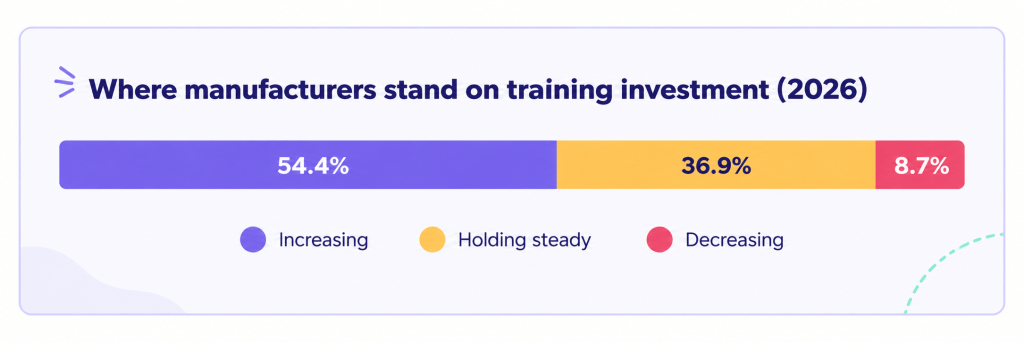
A majority of manufacturers are still leaning in. But a growing minority is pulling back, and that's the part worth sitting with.
Training budgets are usually the last thing anyone cuts.
Everyone already knows the skills gap doesn't close on its own. So when a chunk of the industry cuts training anyway, it's rarely because leadership stopped caring about skills.
It's because the training wasn't proving its worth fast enough to defend when the budget got tight.
The workforce math nobody’s doing
Here's the context that gets left out of every "$32 billion" headline I've read.
- A quarter of the U.S. manufacturing workforce is 55 or older today, up from 10% in 1995.
- Over that same stretch, the total workforce shrank from 20.5 million to 15 million (McKinsey).
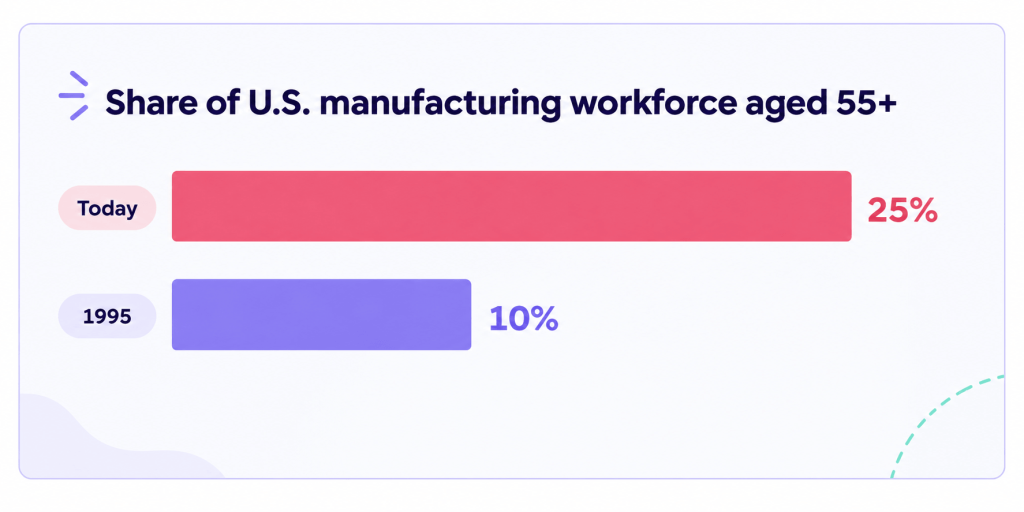
Fewer people are doing the work. A growing share of the people who actually know how to do it well are getting close to retirement.
That's a headcount problem.
Here's the part that makes it worse: only about a third of critical manufacturing roles have an active succession plan, according to research citing McKinsey.
*An active succession plan means someone has actually named who steps into that role next and is deliberately building that person's skills for it, not just hoping a capable replacement turns up when the seat opens.*
For two-thirds of the roles where experience matters most, that identification and preparation isn't happening at all.
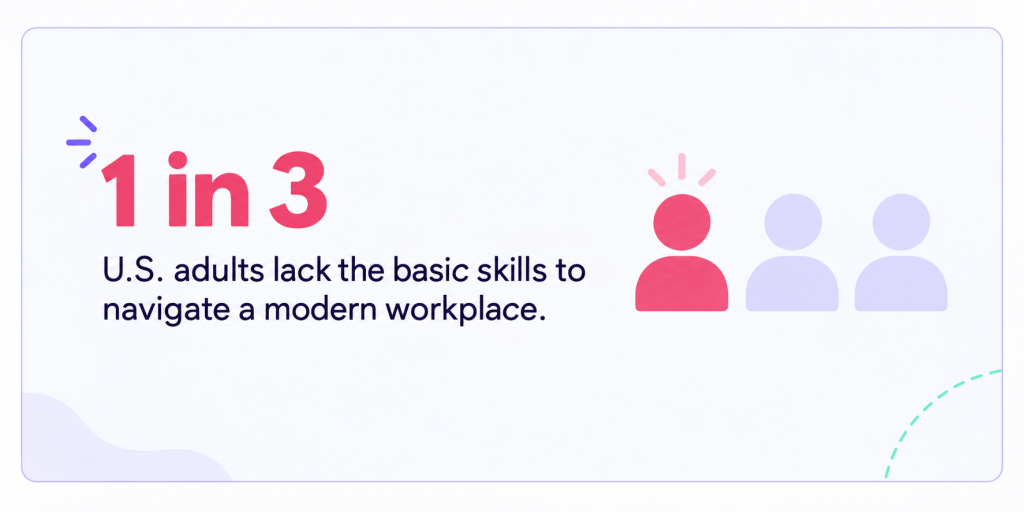
But naming a successor doesn't capture what he knows.
A veteran's judgment isn't written down anywhere, it's a pattern built from doing the job ten thousand times.
You can't read your way into it.
Most plants find that out too late: a 30-year operator gives two weeks' notice, and there's no time left to capture anything. Scenario-based practice, built from that operator's own decisions while he's still on the floor, is how you catch that judgment before it walks out with him.
The same blind spot is playing out again right now. Just with a different technology.
Manufacturers are betting big on AI, almost nobody’s trained to use it
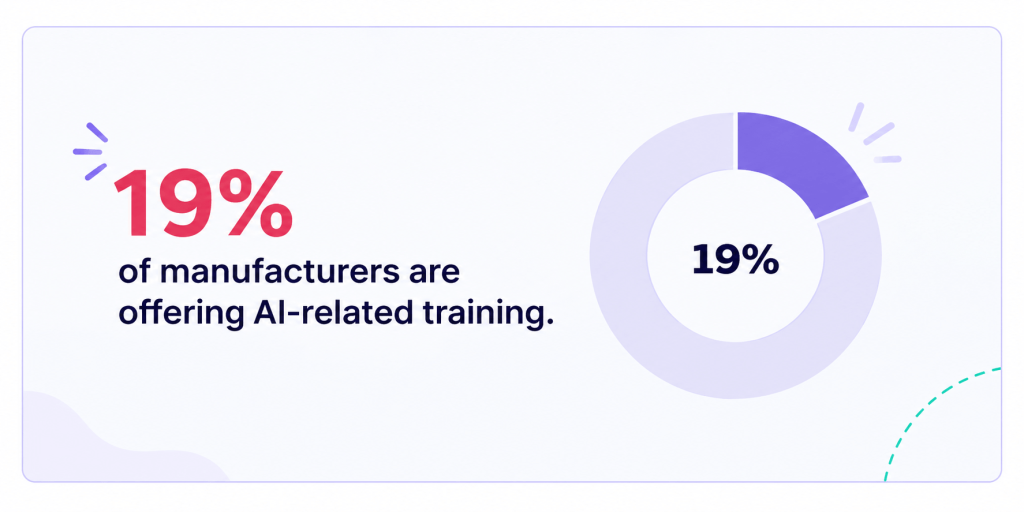
- 19% of manufacturers currently offer AI-related training (Manufacturing Institute, PwC).
- Google.org committed $10 million to close that gap, funding two courses aimed at 40,000 workers: AI 101 for Manufacturing and Advanced AI for Manufacturing Technicians.
Here's the pattern worth noticing.
This isn't really about AI. It's what happens every single time a new technology lands on the floor before the training to use it does. The tool shows up first. The training format that can actually teach it shows up months, sometimes years, later. The gap in between gets measured in scrap, downtime, and safety incidents.
Where do manufacturers get it right?
- Nearly a third of manufacturers now run apprenticeship programs.
- Tesla's Gigafactory pipeline through Truckee Meadows Community College went from 85 apprentices in 2023 to over 1,000 completers today.
- GM put nearly $200 million into its skilled trades pipeline this past year alone.
These aren't small bets.
They prove two things at once: the appetite for serious training investment is real, and when manufacturers commit to it, it pays off in a measurable, growing pipeline of skilled workers.
Where does all the money stop converting?
Most training still proves attendance over capability.
A worker finishes a module, the LMS logs it, and the report says "trained." Whether he can actually do the job under real pressure is a completely different question, and most systems never bother asking it.
Tacit knowledge makes this worse. The kind that lives in a veteran's hands and instincts almost never survives translation into a static course. It gets flattened into a checklist. And checklists don't catch the edge cases that actually cause downtime, scrap, or a trip to the emergency room.
What manufacturers need to fix first?
The problems above aren't separate. They're the same gap showing up in four places: scheduling, succession, AI adoption, and measurement. Closing it takes a few specific shifts, not a bigger budget.
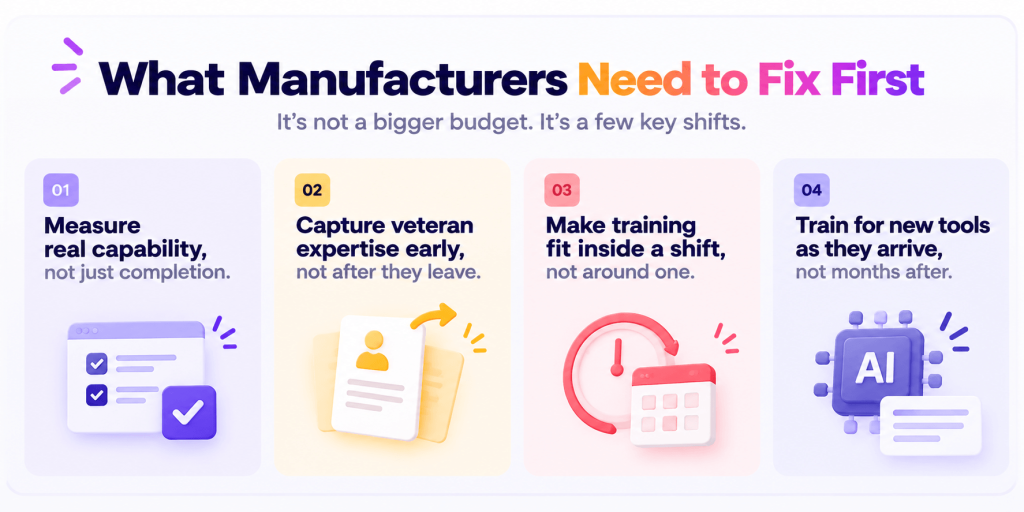
- Stop measuring training by completion. Track whether a worker can actually perform the task under real conditions, not whether the LMS logged a finished module.
- Capture a veteran's judgment before he gives notice, not after. Waiting for a formal succession plan misses the two-thirds of critical roles that don't have one, and even a named successor doesn't inherit the judgment itself.
- Build training that fits inside a shift, not around one. The obstacle isn't cost, it's scheduling and interrupted work hours, so the format has to change, not just the funding.
- Train for the tool at the same time it arrives, not months after. The AI gap exists because manufacturers keep repeating the same pattern: deploy first, train later. That gap is measured in scrap and downtime every time it happens.
None of this requires a bigger check. It requires spending the $31.9 billion already committed on formats that actually close these four gaps instead of formats that just document that training happened.
What’s changing and where does the Nano LMS fit?
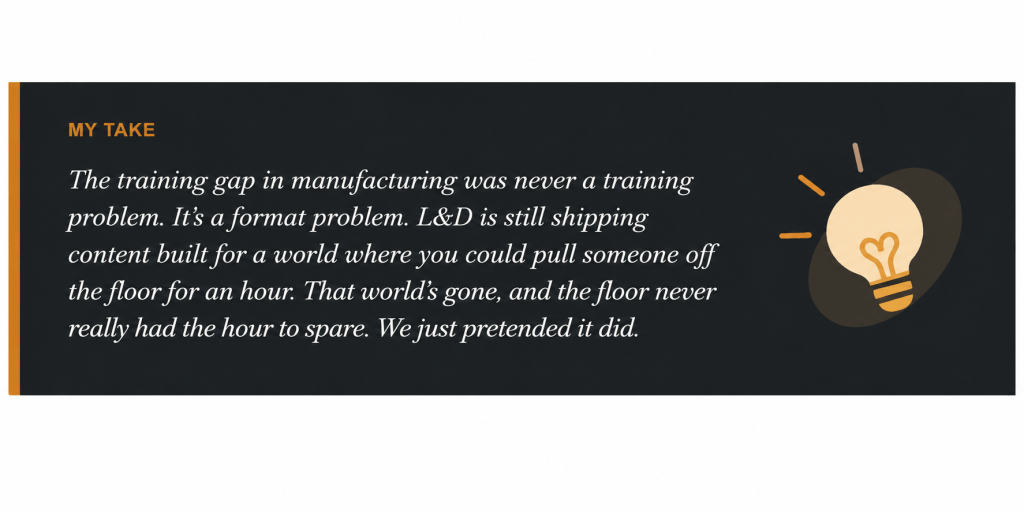
The fix was never a bigger budget. Manufacturers already answered that question. $31.9 billion says the intent is there.
Scenario-based learning and AI roleplay are built for the world that's actually here: turn an existing SOP into something a worker can practice in minutes, not months, standing at the line instead of sitting in a classroom.
That's the whole premise behind Nano LMS.
FAQs
What is manufacturing training?
Manufacturing training refers to the programs manufacturers use to prepare new hires and upskill existing employees on equipment operation, safety procedures, compliance requirements, and role-specific technical skills. It includes everything from onboarding and SOP training to apprenticeships and ongoing skills development for existing workers.
What's the biggest obstacle to manufacturing training?
Cost isn't the top barrier. Interrupted work hours (cited by 68.9% of manufacturers) and scheduling conflicts (65.1%) both rank higher than cost (47.6%) as obstacles to training, pointing to a delivery problem rather than a budget one.
What is the manufacturing skills gap?
The manufacturing skills gap refers to the mismatch between the skills manufacturers need and the skills available in the current workforce. It's driven in part by an aging workforce, with about a quarter of manufacturing employees now 55 or older, and by new technology, including AI, arriving on the floor faster than the training to use it does.
What is scenario-based learning in manufacturing?
Scenario-based learning (SBL) is a training method that has workers practice realistic, job-specific situations, like a machine malfunction or a safety escalation, in a simulated environment before they encounter them on the floor. It's designed to build actual response capability rather than just testing recall through a quiz.
How is AI used in manufacturing training?
AI-driven training tools can turn existing SOPs and expert knowledge into practiceable scenarios and roleplay exercises, help personalize training pace and language for individual workers, and make it possible to train on-demand in short sessions that fit inside a shift instead of requiring a scheduled classroom block. Despite this potential, only 19% of manufacturers currently offer AI-related training themselves.
What is a manufacturing LMS?
A manufacturing LMS (learning management system) is software built to deliver, track, and manage training specifically for manufacturing environments, often accounting for shift-based schedules, multilingual and deskless workforces, compliance and certification tracking, and hands-on or scenario-based skill practice rather than just course delivery.