
Scenario-Based Learning vs Simulation-Based Learning: Which One Does Your Training Actually Need?
Let me ask you something before we start.
If you're training a new sales rep to handle a tough objection, and you're also training a surgeon to perform a procedure, should you use the same method for both?
Obviously not. And yet most companies reach for whatever their LMS happens to offer and apply it to everything. That's how you end up over-engineering a simple skill and under-preparing people for a complex one.
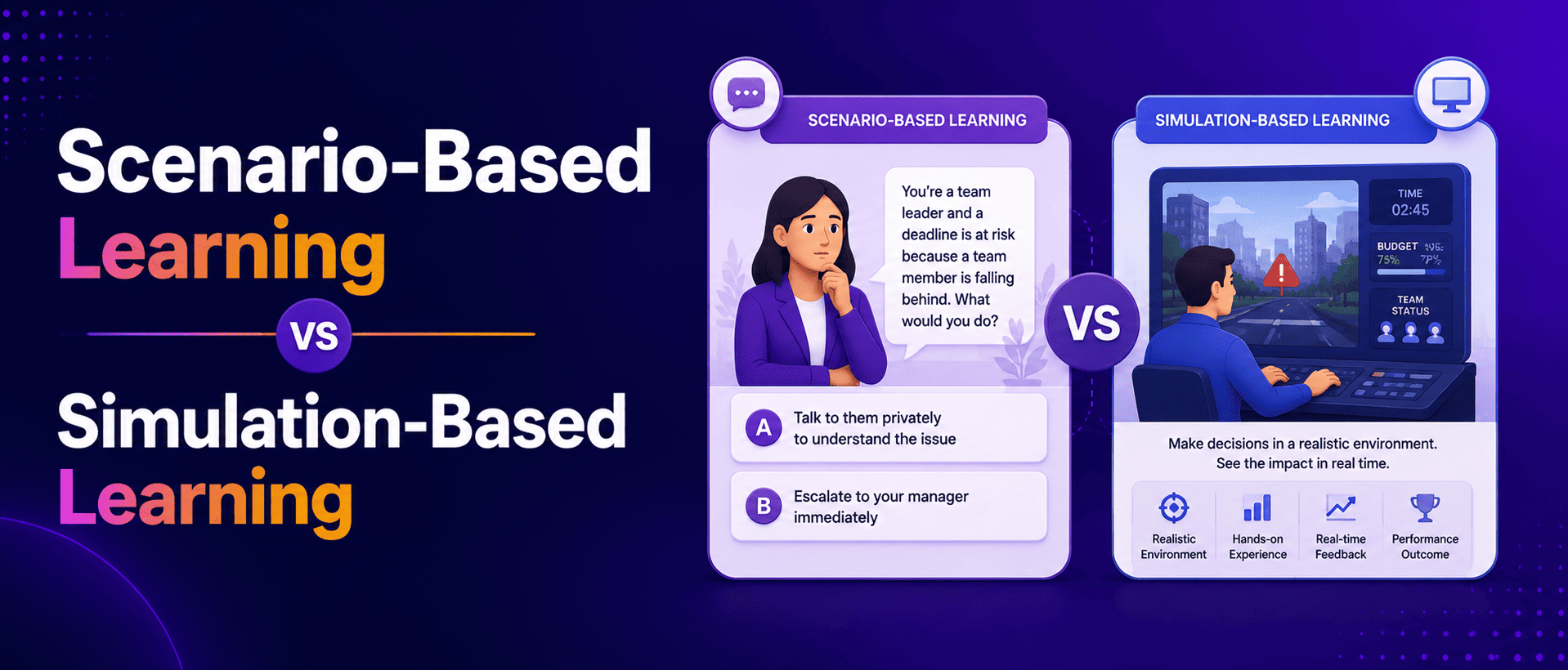
Scenario-based learning and simulation-based learning get confused constantly. People use the terms interchangeably. They're not the same thing. They solve different problems, cost wildly different amounts, and produce different results. Picking the wrong one wastes money on one end and risks real failure on the other.
So let's settle it. By the end of this post you'll know exactly what each one is, when to use which, how to build both, which drives more business impact, and how AI just changed the economics of the entire decision. Let's get into it.
Table of Contents
- The Short Answer
- What Is Scenario-Based Learning?
- What Is Simulation-Based Learning?
- The Core Difference (One Idea to Remember)
- Live Examples of Each
- The Full Comparison Table (Cost, Time, Everything)
- Industries and Use Cases for Each
- How to Build a Scenario-Based Course
- How to Build a Simulation
- How to Pick the Right One
- Which Has More Business Impact?
- How AI Changes Both
- FAQ
The Short Answer
If you're impatient, here's the whole post in four sentences.
Scenario-based learning teaches judgment: what decision to make when a situation is messy. Simulation-based learning teaches execution: how to perform a task accurately, often under realistic conditions. Scenarios are fast and cheap to build and cover the vast majority of corporate training needs. Simulations are expensive and complex to build, and you reserve them for high-stakes skills where getting it wrong in real life is dangerous or costly.
Now let's understand why, because the nuance is where the money is.
What Is Scenario-Based Learning?
Scenario-based learning drops a learner into a realistic situation, asks them to make a decision, and shows the consequence of that choice. It's about judgment. The right answer usually depends on reading the situation, not following a fixed sequence.
Think of a customer service rep facing an angry customer. There's no single button to press. The right move depends on the customer's mood, the policy, and the moment. A scenario lets the rep practice that judgment safely, get it wrong without consequences, and build the instinct for next time.
The defining trait: scenarios are about decisions in gray areas. They shine for soft skills, communication, ethics, sales, and any situation where "it depends" is the honest answer.
What Is Simulation-Based Learning?
Simulation-based learning recreates a real environment or system and lets the learner practice performing within it, as realistically as possible. It's about execution under conditions that mimic reality.
Think of a pilot in a flight simulator, a surgeon on a surgical trainer, or a factory worker running a digital twin of a real machine. The point isn't "what would you decide here." The point is "can you actually do this, correctly, with your hands and your timing, when it counts."
Simulations model a system with real fidelity. They often track precise performance: did you complete the steps, in the right order, within tolerance. Research in clinical training consistently shows that this kind of high-fidelity, repeated practice improves real-world performance and procedural confidence, which is exactly why hospitals invest so heavily in it.
The defining trait: simulations are about performing a task accurately in a realistic model of the real thing.
The Core Difference (One Idea to Remember)
If you forget everything else, remember this.
Scenario-based learning trains the decision. Simulation-based learning trains the doing.
A scenario asks, "What's the right call here?" A simulation asks, "Can you actually pull it off?"
Sometimes you need both, layered. A medical team might use a scenario to practice the judgment call of when to escalate, and a simulation to practice the physical procedure once they've escalated. But they are distinct tools, and most of the time a given skill leans clearly toward one or the other.
Live Examples of Each
are about choosing well in a human, messy moment.
are about performing accurately inside a faithful model of a real system.
Abstract definitions only get you so far. Here's what each looks like in the wild.
Scenario-based learning, live:
- A new sales rep practices a discovery call where an AI buyer raises a price objection, and the rep chooses how to respond and sees the deal move or stall.
- A manager works through a scenario where an employee comes to them in tears the morning a layoff is rumored, and they choose how to respond.
- An employee receives a suspicious email asking for gift cards and decides whether to act, reply, or verify through another channel.
- A retail associate handles a customer demanding a refund outside the return window.
Simulation-based learning, live:
- A pilot flies a full-motion flight simulator through an engine failure on takeoff.
- A surgical resident practices a laparoscopic procedure on a high-fidelity surgical trainer that responds to pressure and technique.
- A nurse runs a patient-deterioration simulation on a manikin that shows real vital signs changing in response to their actions.
- A new plant operator runs a digital twin of a chemical process and has to keep it stable as conditions shift.
- A business student runs a market simulation, like the ones Harvard Business School Publishing builds, making pricing and strategy decisions across simulated quarters and watching the market react.
Notice the pattern. The scenarios are about choosing well in a human, messy moment. The simulations are about performing accurately inside a faithful model of a real system.
The Full Comparison Table (Cost, Time, Everything)
Here's the side-by-side, holding nothing back.
That last row is the one executives feel. A simulation can easily cost ten times or more what a scenario costs to produce. That single fact drives most of the right decision.
Industries and Use Cases for Each
Here's where each method earns its keep.
A quick honesty check. Most corporate training, the day-to-day onboarding, compliance, sales, and soft-skills work that fills the average company's calendar, is a judgment problem, not an execution problem. That's why scenario-based learning covers far more ground for far more organizations. Simulation is the specialist tool you bring in for the high-stakes, high-fidelity minority.
How to Build a Scenario-Based Course
Six steps, and you can move fast.
- Find the real decision. Identify the exact moment where people get it wrong on the job. That moment is your scenario.
- Write the realistic setup. Set the scene the way it actually happens, with a real character and real pressure.
- Create the decision point. Offer three or four choices where every wrong option is genuinely tempting, because those are the mistakes people actually make.
- Branch the consequences. The right choice moves toward a good outcome. Wrong choices visibly make things worse, then let the learner recover.
- Give feedback in the moment. The instant they choose, show them why it worked or backfired.
- Let them retry. Failing and trying again is the whole point.
Realistic timeline: a focused scenario can go from idea to published in a day or two.
How to Build a Simulation
Simulations are a different animal. The steps are heavier.
- Define the system to model. What real environment, machine, or process are you recreating, and at what fidelity?
- Map every variable and state. A simulation has to respond realistically to a wide range of inputs, so you must model the underlying logic.
- Build or source the environment. This often means engineers, 3D modelers, subject-matter experts, and sometimes hardware (VR rigs, manikins, physical trainers).
- Define performance metrics. Decide exactly what "done correctly" means: steps, order, timing, tolerances.
- Test for fidelity. The simulation has to behave like the real thing closely enough to transfer. This testing is extensive.
- Validate transfer. Confirm that performance in the simulation actually predicts performance in reality. In clinical and aviation settings this validation is rigorous and ongoing.
Realistic timeline: weeks to many months, with a specialist team and a real budget. This is why simulation is reserved for skills where the investment is clearly justified.
How to Pick the Right One
Run your training need through these questions in order.
- Is the skill mostly a decision, or mostly a physical or technical execution? Decision points to scenario. Execution points to simulation.
- What happens if someone gets it wrong in real life? Recoverable means a scenario is fine. Dangerous or very costly justifies a simulation.
- How much fidelity do you actually need? If a realistic situation is enough, build a scenario. If you need the system to respond like the real machine or body, build a simulation.
- What's your budget and timeline? Limited means scenario. Significant and justified by the stakes means simulation is on the table.
- How often will it change? Frequent changes favor scenarios, which are easy to edit.
Here's a simple flow to make it concrete:
Decision / judgmentPhysical / technicalexecutionNoYes, but still a judgmentcallNo, a situation is enoughYes, full fidelity neededWhat does this skillrequire?Decision orExecution?High stakes ifwrong IRL?Need realisticsystem response?Scenario-Based LearningSimulation-Based Learning
For most teams, most of the time, the honest answer lands on scenario. Simulation is the deliberate exception you make when the stakes and the budget both say yes.
Which Has More Business Impact?
This is the question executives actually care about, so let's be precise.
First, the context. Corporate L&D is a massive investment, the global market sits around $350 billion and keeps growing, and yet roughly 75% of senior managers say they're dissatisfied with their L&D, while around 70% of employees feel they lack the skills they need for their jobs. Money is being spent. Skills are not landing. That gap is the real problem both methods exist to solve.
So which closes it harder? The honest answer is: it depends on what you measure and at what scale.
Simulation wins on depth. For a specific high-stakes skill, a good simulation produces deep, durable competence that's hard to match. A pilot who has handled the engine failure fifty times in the sim is genuinely more capable. The per-learner impact is enormous. The catch is that the cost and complexity limit how broadly you can deploy it.
Scenario wins on breadth and ROI. Because scenarios are cheap and fast, you can deploy them across the entire workforce and hit the huge volume of everyday judgment skills that quietly drive performance: the sales calls, the customer interactions, the compliance decisions, the management moments. The per-learner impact on any single skill may be smaller than a simulation's, but multiplied across thousands of employees and hundreds of decisions, the total business impact is often larger and the return on investment is dramatically higher.
The practical takeaway for most organizations: scenario-based learning will move more of your business, more cheaply, across more of your people. Simulation delivers irreplaceable depth on the narrow set of skills that truly require it. A mature L&D strategy uses scenarios as the broad default and simulations as the targeted, high-value exception.
How AI Changes Both
Here's where the ground is shifting under everyone's feet, and it's the most important section in this post.
The split that matters: most simulation value now lives in the affordable middle — AI roleplay — while only a narrow, high-stakes set still needs specialist hardware.
For decades, the cost gap between these two methods was a hard constraint. Scenarios were merely expensive to build well. Simulations were prohibitively so. AI is collapsing both costs, but not equally, and that asymmetry is the whole story.
After AIBefore AIcost collapsesnew middle layer appearsnarrow set remainsScenarios:expensive, days of workSimulations:prohibitive, months +hardwareScenarios:minutes, near-freeAI Roleplay:affordable conversationsimHigh-fidelity Sim:still specialist + hardware
Shift 1: AI makes scenarios nearly free to produce
This is the bigger story, so start here.
The old bottleneck for scenarios was authoring. You wrote every branch, every consequence, every piece of feedback, then wired it all together in a complex tool with a real learning curve. That's the work that ate the days.
With an AI-native platform, that work compresses into a conversation. You describe the situation in plain language and the AI drafts the branches, the consequences, the feedback, even the voices and the visuals. What used to take days of specialist effort now takes minutes.
The implication is bigger than "faster." The last real barrier to scenario-based learning was build time. That barrier is essentially gone. So the method that already had the best ROI just got radically cheaper to deploy at scale. The economics didn't improve. They flipped.
Shift 2: AI roleplay creates a brand-new middle category
Here's the part almost nobody has internalized yet.
True high-fidelity simulation, the flight sim, the surgical trainer, still needs specialized engineering and hardware. AI doesn't magic that away, and this post won't pretend it does.
But for an enormous category of skills, conversational AI roleplay now delivers something that lives between a scenario and a simulation:
- A branching scenario gives you a fixed set of paths someone wrote in advance.
- A traditional simulation models a real system with full fidelity, at full cost.
- AI roleplay sits in the middle: a live partner that pushes back, gets frustrated, and adapts in real time, with infinite variation and instant feedback.
When a sales rep practices against an AI buyer who reacts differently every time, that's no longer just a branching scenario. It's a responsive simulation of the conversation. For any skill whose "system" is another human being, a sales call, a tough feedback talk, a de-escalation, a negotiation, AI roleplay collapses the old cost of simulation dramatically.
What this means for your strategy
Put the two shifts together and the playbook gets simple:
That third row is much smaller than most training budgets currently assume. A lot of what gets treated as "too complex and expensive to simulate" is actually a conversation, and conversations are exactly what AI roleplay now handles affordably.
The companies that win the next few years of L&D will be the ones that stop treating rich, responsive training as a luxury.
AI has made the most effective methods the most affordable ones. That's a rare moment in any industry, where the best option and the cheapest option become the same option. It's worth moving on.
FAQ
What is the difference between scenario-based learning and simulation-based learning? Scenario-based learning trains judgment by having learners make decisions in realistic situations and see the consequences. Simulation-based learning trains execution by recreating a real environment or system and having learners perform tasks within it. Scenarios are about deciding; simulations are about doing.
Which is more expensive, scenarios or simulations? Simulations are significantly more expensive, often ten times or more per build, because they require modeling a real system with high fidelity, specialized skills, and sometimes hardware. Scenarios are far cheaper and faster to produce.
When should I use a simulation instead of a scenario? Use a simulation when the skill is a physical or technical execution, when getting it wrong in real life is dangerous or very costly, and when you need a realistic model of the actual system. Aviation, surgery, and plant operations are classic cases.
Which has more business impact? For a single high-stakes skill, simulations deliver deeper competence. Across an entire workforce, scenario-based learning usually drives more total business impact and far higher ROI because it's cheap enough to deploy broadly against the huge volume of everyday judgment skills.
How is AI changing scenario and simulation learning? AI has made scenario-based learning nearly free and fast to produce, since you can describe a scenario in plain language and have the AI build it. It has also turned conversational AI roleplay into an affordable simulation layer for any people-facing skill, while traditional high-fidelity simulations still require specialized engineering.
Want to build responsive, branching scenarios and AI roleplays without the old cost or build time? Nano LMS creates them from a plain-language description in minutes, with mobile delivery and tracking built in. Free to start, no credit card.